
How to Build a Clemency Petition That Gets Read (Not Just Filed)

13 Min. Read
What the Office of the Pardon Attorney Looks For, and How to Give It to Them
Across the last three presidential administrations, more than 22,000 federal clemency petitions were closed without any presidential decision at all, according to the Department of Justice's published clemency statistics. Not denied. Closed. The file went in, the term ended, and nobody ever ruled on it. This post breaks down what the Office of the Pardon Attorney is actually evaluating, the five elements that show up in every serious petition, the mistakes that quietly kill a file, and how the process differs if your conviction is federal, Tennessee, or North Carolina.
TL;DR
Clemency is executive mercy: a pardon, commutation, or reprieve granted by a President or Governor.
The odds are real but thin: federal pardon grant rates have run roughly 5 to 7 percent per administration.
Five years is the standard wait: federal, Tennessee, and North Carolina all use it for pardons.
Evidence beats sympathy: what you built after the conviction carries the file.
Letters matter more than people think: federal wants 3 non-family affidavits, Tennessee wants 5.
First step: pull your certified judgment and docket before you write a single word.

The Office of the Pardon Attorney assists the President in the exercise of executive clemency. Edward R. Martin Jr. was appointed the U.S. Pardon Attorney on May 14, 2025.
What Does the Office of the Pardon Attorney Actually Look For?
Unfortunately, the Office of the Pardon Attorney is not looking for a sad story no matter how compelling, but they do look at evidence. Clemency, which is the power of a U.S. President or state governor to forgive a conviction or shorten a sentence, is the one post-conviction remedy where no judge decides anything. The Supreme Court called it "the historic remedy for preventing miscarriages of justice where judicial process has been exhausted" in Herrera v. Collins, 506 U.S. 390 (1993), and described it as the "fail safe" in the criminal justice system. That framing cuts both ways: clemency is discretionary, so no court can order the President or governor to grant it and no court can review a denial.
So unlike other types of post-conviction relief, you’re not trying to appeal to a judge, but rather a career attorney inside the Department of Justice working through a stack, and then, if your file survives, the President.
The federal standards are published. Justice Manual section 9-140.112 lists five factors the Office of the Pardon Attorney weighs on a pardon petition, and they are worth reading in the order the government wrote them, because that order tells you what to lead with.
Post-conviction conduct, character, and reputation. The Justice Manual calls "demonstrated ability to lead a responsible and productive life for a significant period after conviction or release from confinement" strong evidence of rehabilitation and worthiness.
Seriousness and relative recentness of the offense. For violent crime, major drug trafficking, breach of public trust, or large-dollar fraud, the Justice Manual expects "a suitable length of time" to have passed.
Acceptance of responsibility, remorse, and atonement. Restitution to victims is specifically named.
Need for relief. A concrete legal disability created by the conviction, not a general wish for closure.
Official recommendations and reports. The views of the prosecuting United States Attorney and the sentencing judge are, in the government's own words, "carefully considered."
Commutations are judged differently. Justice Manual section 9-140.113 lists disparity or undue severity of sentence, critical illness or old age, and meritorious service to the government, such as cooperation that was never adequately rewarded. Note what is missing from that list: general rehabilitation alone is not a listed ground for a federal commutation, though it supports one. And under 28 C.F.R. § 1.3, a commutation petition should not be filed at all if other judicial or administrative relief is still available, absent exceptional circumstances.
That last rule catches people constantly. If a compassionate release motion or a post-conviction claim is still on the table, a commutation petition can be closed on procedural grounds before anyone reads the merits.
What This Means For You:The government has told you, in writing, what it grades. A petition that answers all five factors with documents attached is not just more persuasive, it is easier to process, and easy to process is how a file moves.
Key Points:
Federal pardons require a five-year wait after release under 28 C.F.R. § 1.2
Post-conviction conduct is the first factor listed, not the last
Commutations need a listed ground: disparity, illness or age, or meritorious service
Filing while other relief is pending can get a commutation closed without review
How Does the Clemency Process Differ by Jurisdiction?
Where your conviction happened decides who actually reads your petition, what you have to put in that file, and whether you'll ever get to speak with an actual person about it. All Federal convictions go through the Department of Justice; Tennessee, and North Carolina run clemency through a different gatekeeper.
Federal: A Paper Process Run Through the Department of Justice
Even though people call it a presidential pardon, you're not filing with the President, you're filing with the Office of the Pardon Attorney under the United States Department of Justice. Under 28 C.F.R. § 1.1, your petition is addressed to the President on paper, but you actually submit it to the Pardon Attorney in Washington, and the one exception is a military offense tried by court-martial, which goes to the Secretary of that military department instead.
You'll need to wait five years, and there's essentially no way around it. Under 28 C.F.R. § 1.2, you can't file a pardon petition until five years after your release from confinement, or five years after conviction if you never served time, and if you're still on probation, parole, or supervised release, you generally shouldn't file at all: the DOJ's pardon instructions call a waiver of that waiting period "rarely granted and then only in the most exceptional circumstances."
Once you file, your petition doesn't just sit in a queue, it gets investigated. Under 28 C.F.R. § 1.6, the Attorney General conducts whatever investigation is necessary, which includes the FBI, before submitting a written recommendation to the President on whether your petition has "sufficient merit to warrant favorable action."
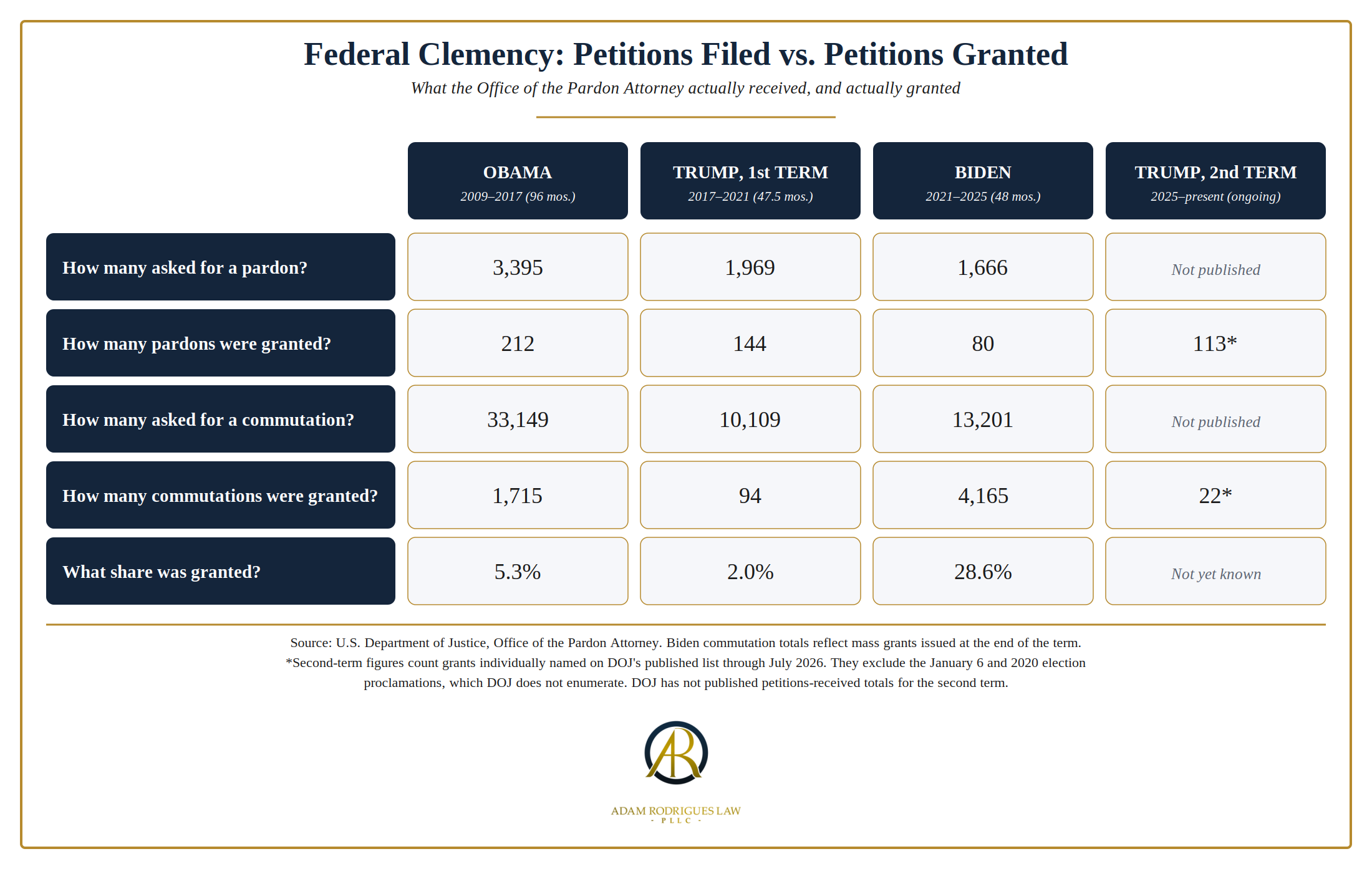
This is exactly why your file needs to be airtight: the numbers are not in your favor. Under the published DOJ statistics, the Obama administration received 3,395 pardon petitions and granted 212, the first Trump administration received 1,969 and granted 144, and the Biden administration received 1,666 and granted just 80. Biden's commutation figure looks like an outlier at first glance, and it is: those 4,165 grants came overwhelmingly from mass commutations issued in the final weeks of the term, not from individual petitions that worked their way through the Pardon Attorney. For Trump’s current, second term, the Department of Justice has not published the totals of petitions received yet, only those granted here.
Key Takeaway: If you're filing a petition and waiting for it to be read on its merits, the honest number to plan around is the pardon rate, which has sat between 5-7% for the last three completed administrations.
Tennessee: The Board of Parole Is the Real Audience
In Tennessee, the Governor grants clemency, but the Board of Parole decides whether the Governor ever hears about you. Under Tenn. Code Ann. § 40-27-101, "the governor has power to grant reprieves, commutations and pardons in all criminal cases after conviction, except impeachment," but you don't go straight to the Governor: your application routes first through the Board of Parole's Executive Clemency Unit under Tenn. Comp. R. & Regs. 1100-01-01-.16, and the Board's recommendation, while influential, is expressly non-binding.
Tennessee recognizes three forms of clemency: pardon, commutation, and exoneration. The Governor's published criteria, set out in the Board of Parole's clemency FAQ, require you to have gone five years since completing your sentence with no new conviction, confinement, or community supervision, and to show "exemplary citizenship," meaning both specific achievements and a clean record since, verified in writing by at least five people who aren't you or your family. While the Governor is not bound to the published FAQ, exceptions are only granted in exceptional circumstances. If you're also claiming a compelling reason for the pardon, that needs separate verification from at least one more non-family source.
There's one line in those criteria that quietly decides a lot of Tennessee files: the reason for a pardon generally won't be found compelling when another provision of law, like the expungement statutes, already gets you the relief you're after. If your actual goal is a clean background check and you qualify under Tenn. Code Ann. § 40-32-101, Tennessee may tell you to use that door instead.
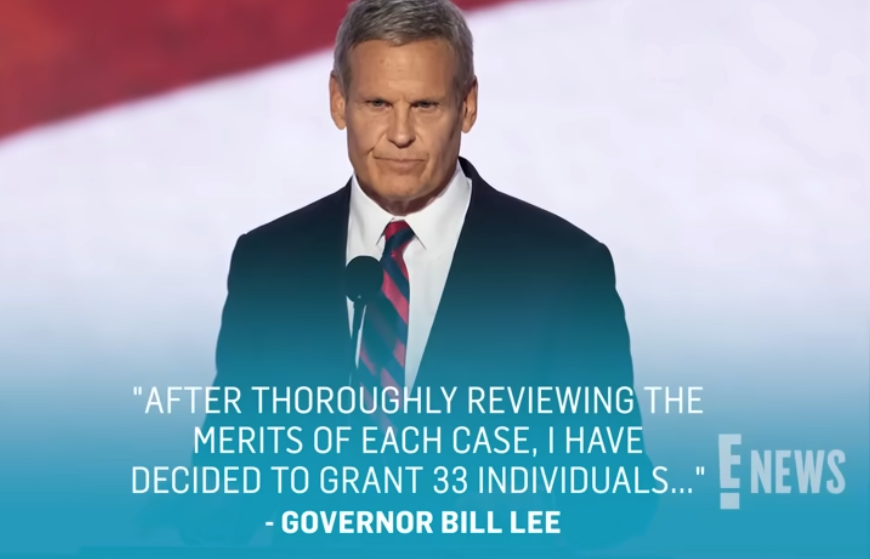
On December 18, 2025, Governor Bill Lee granted executive clemency to 33 people, including the country artist Jelly Roll, who has spoken openly about the arrests and the aggravated robbery conviction behind him. Note what that pardon did and did not do, though: it forgave the convictions, it did not erase them. Under the Board of Parole's own guidance, expungement is still a separate petition.
Attorney Insight:
“If a client is still serving time, we run clemency alongside other tools. In Tennessee that can mean exploring sentence-reduction avenues while the clemency file matures. Different tracks, same goal.”
Exoneration is the outlier, and it's the one path that does everything at once. Under Tenn. Code Ann. § 40-27-109, a gubernatorial exoneration expunges all records of the arrest, indictment, and conviction and automatically restores your citizenship rights, with no separate expungement application required, but you'll need a finding that you didn't commit the crime and proof that you've exhausted every state judicial remedy first.
Key Takeaway: For Tennessee clemency filing, treat the Board of Parole as the main audience and the Governor as the appeal. If the Board never finds a hearing is merited, your name may never reach the Governor's desk at all, and there is no appeal from that.
North Carolina: A Written Petition to the Governor's Clemency Office
Unlike Tennessee, North Carolina runs clemency straight out of the Governor's office, with no parole board standing in between. Article III, Section 5(6) of the North Carolina Constitution gives the Governor power to "grant reprieves, commutations, and pardons, after conviction, for all offenses (except in cases of impeachment)," and to get there, the Executive Clemency Office requires you to submit a written petition signed by you or a representative, a statement of your grounds for clemency, and certified copies of the indictment and judgment. And although there's no board standing between you and the Governor, North Carolina divides pardons into three kinds, and picking the wrong one can cost you the exact relief you were after:
Pardon of Forgiveness: Forgives the conviction, and can be issued with conditions or restrictions that may trigger revocation if you violate them. It does not automatically expunge your record or restore your firearm rights, though it does let you apply to have your right to bear arms restored.
Unconditional Pardon: A pardon issued without any conditions attached.
Pardon of Innocence: Issued when the Governor determines you did not commit the offense. This is the only one that authorizes expungement of your court and DNA records, and it opens the door to state compensation.
Additionally, the waiting periods are specific and depend entirely on which type of clemency you're asking for. Per the Executive Clemency Office, if you want a Pardon of Forgiveness you'll wait five years after release, but a Pardon of Innocence has no waiting period at all.
Commutation, though, runs on its own timeline: Class A or B1 felons need to have served at least five years, everyone else needs at least one, and no one can apply within a year of their projected release date. If you're denied, most applicants wait three years to reapply and Class A or B1 felons wait five.
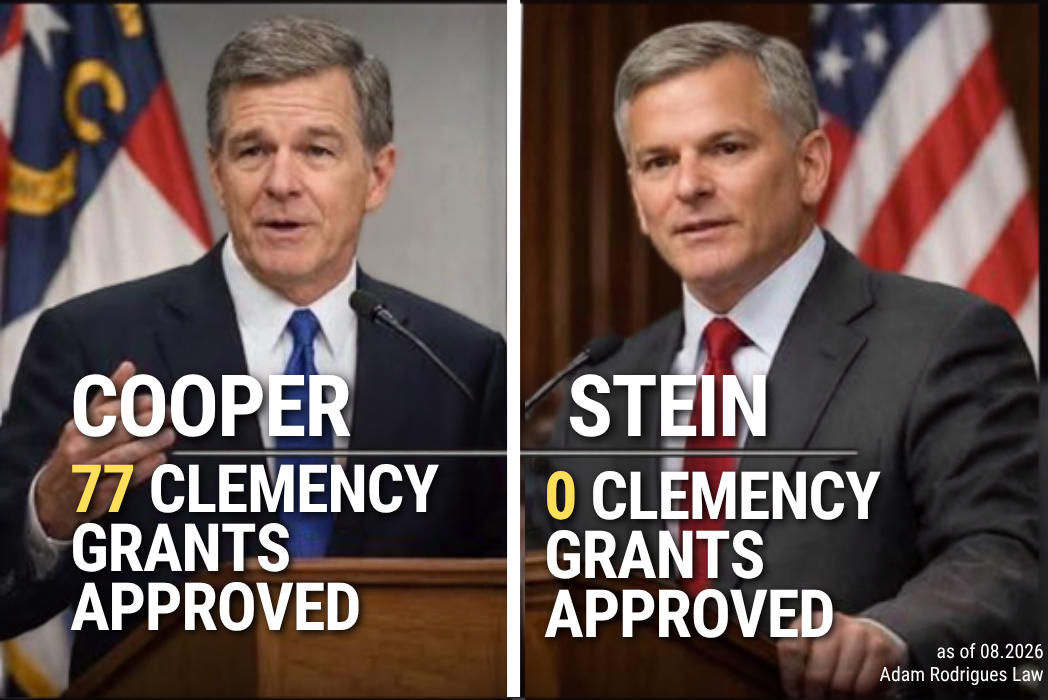
Both governors exercise the same power, but use it very differently. During Cooper's 8 years in office, the 15 death sentence commutations on December 31, 2024 were the broadest clemency action by any modern North Carolina governor. As of August 2026, roughly 40% through his term, Governor Josh Stein has not publicly granted any.
Here's the part that matters most if you're filing in North Carolina right now: who is sitting in the Governor's chair changes everything.
Governor Roy Cooper granted 34 pardons and 43 commutations across his eight years, and on December 31, 2024 he commuted 15 death sentences, the most extensive use of clemency by any modern North Carolina governor. He also created the Juvenile Sentence Review Board in 2021 to look at people serving long sentences for crimes committed as children, and 14 of them received clemency.
Current Governor Josh Stein has taken a very different approach. Bolts reported in May 2026 that he denied 58 of the 75 juvenile lifer petitions still waiting when he took office, with four still undecided, and no grants of clemency have been publicly reported since. Both governors hold the identical power under Article III, Section 5(6) of the state constitution, so nothing about the law changed here, only who is reading the files.
What This Means for You: One North Carolina governor set a record approving clemency petitions, and the next has not publicly granted a single pardon or commutation in the nineteen months since he took office on January 1, 2025. He is not yet halfway through his term, so that can still change, though you should not file a petition assuming it will.
Key Takeaway: Governors vary dramatically, and the file you build now may still be sitting there when the next one takes office, so either way, filing in North Carolina means building a petition strong enough that saying no is the harder answer.
How to Build a Strong Clemency Petition
Every jurisdiction's form asks slightly different questions, but the substance of a petition that gets read closely is remarkably consistent. Five elements do the work. Miss one and the file reads as incomplete, which is the fastest way to be set aside without a decision.
Element #1: A Complete, Accurate, Notarized Application
An incomplete application is not a weak petition, it is a non-petition. The DOJ pardon instructions state the form "must be completed fully and accurately and notarized in order to be considered," and warn that failure to complete it fully and accurately "may be construed as a falsification of the petition." Disclosure is broad: every arrest or charge, civilian and military, traffic violations that resulted in arrest, delinquent credit obligations, civil lawsuits, and unpaid taxes.
Tennessee applies the same logic. The Board of Parole states that any person requesting clemency "must first submit a fully completed application," including every question answered and every item on the checklist provided. North Carolina's Executive Clemency Office will not process a petition without certified copies of the indictment and judgment.
When you’re more likely to fail this test:
An old arrest you forgot about surfaces in the FBI background check
A dismissed charge from another state goes undisclosed
The judgment attached is an uncertified printout from a court website
The form is signed but never notarized
When this could work in your favor:
You disclose an unflattering item and explain it in the same breath
Every attachment is certified and matches the docket numbers on the form
Restitution and court costs are documented as paid in full
The narrative and the paperwork tell exactly the same story
Element #2: Documented Post-Conviction Conduct
This is the first factor the government lists, and it is the one applicants underbuild. Justice Manual section 9-140.112 treats a demonstrated ability to lead a responsible and productive life after release as strong evidence of rehabilitation. Tennessee's version, in the Governor's published criteria, is stricter on its face: it asks for "specific achievements and incident-free behavior that indicates an extraordinary transformation."
Both standards reward the same thing, which is a paper trail rather than adjectives.
Evidence that typically qualifies:
Continuous employment records, W-2s, or a letter from a supervisor with dates
Licenses, certifications, degrees, or trade credentials earned after conviction
Sustained volunteer or ministry work documented by the organization itself
Treatment or program completion certificates, with the completion date visible
Evidence that typically falls short:
A resume with no supporting documents behind it
General statements that the applicant "turned his life around"
Programs completed while still incarcerated, offered with nothing since release
A single recent good act with a long gap before it
Element #3: Acceptance of Responsibility That Reads as Genuine
The government weighs remorse and atonement, and it can tell the difference between accepting responsibility and re-litigating the case. Justice Manual section 9-140.112 names acceptance of responsibility, remorse, and restitution to victims as important considerations. A petition that spends four pages arguing the evidence was thin is arguing the wrong case, however sympathetic the argument might be, because clemency is not an appeal and the Pardon Attorney is not reviewing the trial record.
There is a narrow exception worth knowing. Tennessee's exoneration process under Tenn. Code Ann. § 40-27-109 and North Carolina's Pardon of Innocence both exist precisely to address actual innocence. If innocence is your claim, you are on a different track with different proof requirements, and mixing the two arguments in one petition weakens both.
Element #4: A Concrete Need for Relief
"Need for relief" means a specific legal disability, not a general desire for a clean slate. The Justice Manual notes that a felony conviction creates a variety of legal disabilities under state or federal law, "some of which can provide persuasive grounds for recommending a pardon." Name yours. A license your state board denies because of the conviction. A firearms disability. An immigration consequence. A bonding requirement that blocks a specific job you have been offered.
This is also where Tennessee applicants get filtered out. The Governor's criteria say a reason generally will not be compelling when another statute, such as Tenn. Code Ann. § 40-32-101, already offers the relief. Before you write, confirm that clemency is the only door.
Element #5: Letters of Support From the Right People
Letters are graded on who wrote them and what they personally witnessed, not on how many you send. The federal requirement is a floor, not a target: the DOJ instructions call for at least three character affidavits, and persons related by blood or marriage cannot serve as primary character references. Letters are acceptable in place of the office's affidavit form if they carry the reference's full name, address, and telephone number and a notarized signature.
Tennessee asks for more. Under the Governor's criteria, exemplary citizenship must be verified by written communication from at least five people who are neither the petitioner nor family, plus at least one non-family source verifying the compelling reason.
Who to ask, in rough order of weight:
The prosecuting attorney or sentencing judge, if either will write (the Justice Manual says their views are carefully considered)
A current employer or supervisor who can speak to years of work, not weeks
A probation or parole officer who supervised the applicant to a clean discharge
Clergy, program directors, or nonprofit leaders who supervised documented service
Community figures with no personal stake and a long observation window
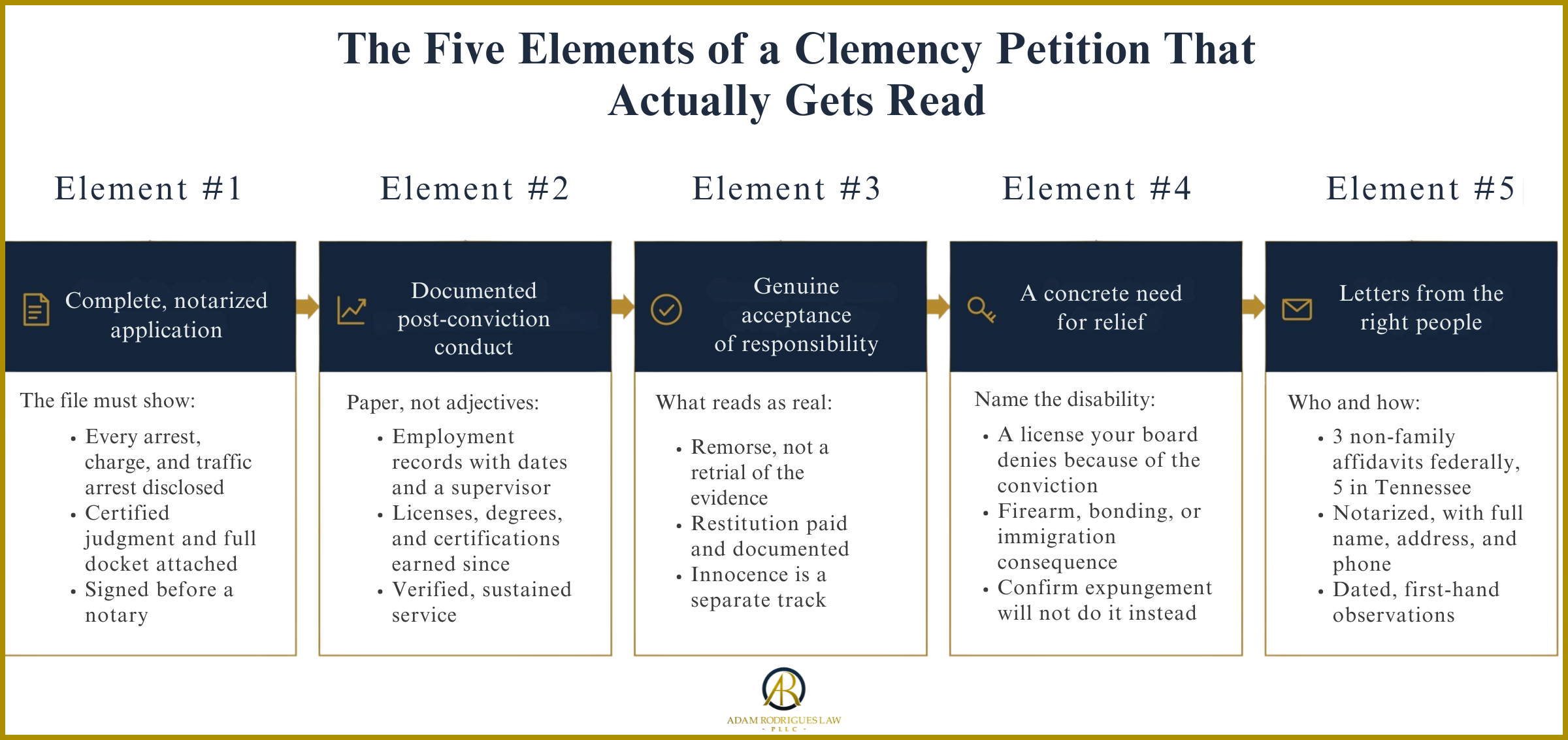
The five elements come from 28 C.F.R. § 1.1 and the pardon factors in Justice Manual section 9-140.112: a complete notarized application, documented post-conviction conduct, genuine acceptance of responsibility, a concrete need for relief, and letters from the right people. Graphic: Adam Rodrigues Law PLLC.
Common Mistakes That Get Clemency Petitions Ignored
Certain errors show up over and over, and almost all of them are avoidable before filing.
Filing too early. 28 C.F.R. § 1.2 sets a five-year wait after release for federal pardons, and applicants still on supervision generally should not file at all.
Filing a commutation while other relief is pending. 28 C.F.R. § 1.3 directs that commutation petitions not be filed when judicial or administrative relief remains available.
Asking for the wrong remedy. A pardon does not shorten a sentence and a commutation does not restore rights. A pardon forgives the offense, while a commutation substitutes a lesser punishment. See our article Clemency, Pardons & Expungement: Decoding Your Post‑Sentence Options
Assuming clemency clears the record. Tennessee's Board of Parole states plainly that a pardon does not clear records; it is a prerequisite to a separate expungement petition. See our article Clemency, Pardons & Expungement: Decoding Your Post‑Sentence Options for more details.
Using family for character references. The DOJ instructions exclude blood and marriage relatives as primary references, and Tennessee excludes family from its five-letter requirement.
Leaving out certified court documents. North Carolina's Executive Clemency Office requires certified indictments and judgments as a threshold matter.
Next Steps: What to Do If You Are Preparing a Clemency Petition
Although, there is no filing deadline on a clemency petition, you should start assembling as early as possible, even if the earliest eligible filing date is years out because collecting your evidence takes time.
Immediate actions:
Order certified copies of the indictment, judgment, and full docket from the convicting court
Confirm your eligibility date under 28 C.F.R. § 1.2, the Tennessee criteria, or the North Carolina rules
Gather proof that restitution, fines, and court costs are paid in full
Build a dated employment, education, and service history with documents behind every entry
Identify five to seven non-family references and ask them for specific, dated observations
Check whether expungement or another remedy already gives you what you need
Building a strong clemency case takes time and expertise. Let us help.
Clemency sits alongside the court remedies, not in place of them, and the right sequence depends on your record. This office handles clemency and pardons, post-conviction relief, and criminal appeals across federal, Tennessee, and North Carolina courts, on flat-rate pricing so you know the cost before the work starts.
Call Adam Rodrigues Law 615-270-2074 or book your private consultation to review your clemency case today.
FAQs
-
Anyone convicted of a federal offense may petition, but timing controls eligibility in practice. Under 28 C.F.R. § 1.2, a pardon petition should not be filed until at least five years after release from confinement, or five years after conviction if no prison sentence was imposed, and people still on probation, parole, or supervised release generally should not file. Commutation petitions under 28 C.F.R. § 1.3 should not be filed while other judicial or administrative relief is still available. State convictions are not eligible for federal clemency at all; those go to the Governor of the convicting state.
-
A pardon is forgiveness for the offense and can restore civil rights, while a commutation reduces or ends a sentence without disturbing the conviction. A commutation as the substitution of a lesser punishment, and separately defines a pardon as relief from the legal consequences of the offense. The federal standards differ too: pardons are graded on the five factors in Justice Manual section 9-140.112, while commutations under section 9-140.113 require a listed ground such as sentence disparity, critical illness or old age, or meritorious service to the government.
-
Unfortunately, there is no fixed timeline anywhere. Federally, the petition is investigated under 28 C.F.R. § 1.6 before any recommendation reaches the President, and the Department of Justice's clemency statistics show thousands of petitions closed at the end of an administration without any decision. Tennessee's Board of Parole states outright that there is no timeline on when and if the Governor will act. Plan in years, and keep supplementing the file while it is pending.
-
No. A pardon forgives the conviction; it does not erase it. Tennessee's Board of Parole explains that a pardon is a prerequisite toward expungement, not a substitute for it, and expungement remains a separate petition under Tenn. Code Ann. § 40-32-101. Two narrow exceptions exist: a Tennessee exoneration under Tenn. Code Ann. § 40-27-109 expunges the records automatically, and a North Carolina Pardon of Innocence authorizes expunction. There is no general federal expungement statute for adult convictions.
-
No, and Tennessee's Board of Parole says directly that having an attorney will not speed the process. What counsel changes is the content of the file: whether the right remedy was chosen, whether every disclosure required by the DOJ instructions is accounted for, whether the supporting documents are certified and consistent, and whether a court remedy should be pursued first. Given that 28 C.F.R. § 1.3 can close a commutation petition filed while other relief is pending, sequencing alone is worth at least a consultation with an experienced clemency attorney.
-
Yes, though the waiting period depends on the jurisdiction. In North Carolina, the Executive Clemency Office requires most denied applicants to wait three years before reapplying, and five years for those convicted of Class A or B1 felonies. In Tennessee, the Board of Parole states there is no appeal from a clemency decision, but a petitioner may reapply under the next Governor's administration, or sooner if applying for a different type of clemency or under different criteria. Use the interval to add documented achievements rather than resubmitting the same file.
-
People who observed you directly, over a long period, and who are not related to you. The DOJ pardon instructions require at least three character affidavits and exclude relatives by blood or marriage as primary references, requiring each letter to carry the writer's full name, address, telephone number, and a notarized signature. Tennessee's Governor's criteria call for at least five non-family writers verifying exemplary citizenship. Employers, supervising officers, clergy, and program directors who can give dates and specifics outperform character letters from friends.
Last Updated: August 11, 2026
Related Articles & Resources
Related Posts:
Clemency, Pardons & Expungement: Decoding Your Post-Sentence Options - which remedy fits which problem, including the immigration overlay
Federal Habeas vs. State Post-Conviction: Which Relief Path Gets Results Faster? - the court remedies to exhaust before clemency
How to Prepare for Your Tennessee Parole Hearing - building a release file for the same Tennessee board
Practice Areas:
Clemency & Pardons - federal and state petitions for pardon, commutation, and exoneration
Post-Conviction Relief - challenging a conviction or sentence after direct appeal
Criminal Appeals - direct appeals in federal, Tennessee, and North Carolina courts
Habeas Corpus - testing whether a detention is lawful in federal court
Compassionate Release - sentence reduction for extraordinary and compelling reasons