
Why Post-Conviction Lawyers Defend Guilty People
A Post-Conviction Attorney Explains
8 Min. Read
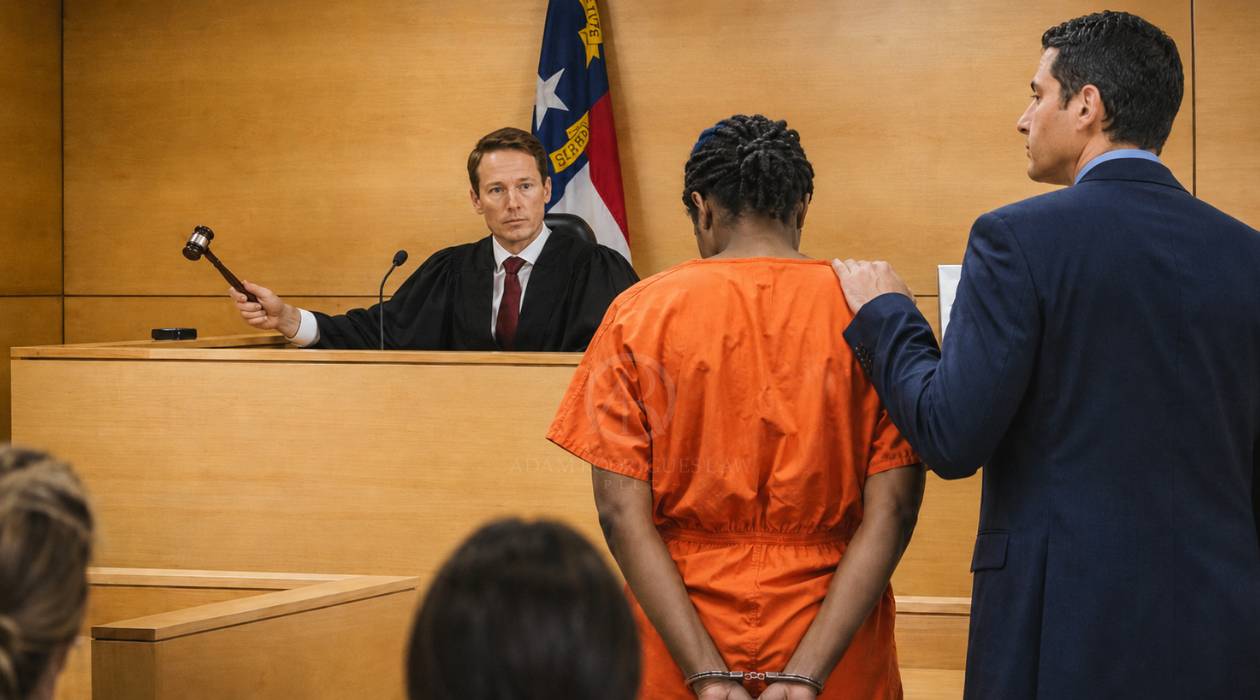
You may already believe your loved one is guilty of a crime they are serving time for, but that doesn’t matter to a post-conviction attorney. The more important question is whether the state originally proved it lawfully and sentenced in accordance with the law.
That distinction is the whole job of post-conviction work, meaning the process of challenging a conviction or sentence after the trial and any direct appeal have ended. It is a fair question to ask a defense lawyer how they sleep at night, though the answer is less dramatic than most people expect. What follows is what "knowing" actually means at this stage, what the 2025 exoneration data shows, and what survives a guilty plea.
TL;DR
Factual guilt and legal guilt are different things. The question is whether the state proved it lawfully.
Post-conviction lawyers rarely know. By this stage the record is the evidence, not a confession.
97 exonerations in 2025. Down from 147, per the National Registry of Exonerations.
Official misconduct is still the pattern. It appeared in 78% of 2025's homicide exonerations.
A guilty plea is not the end. Constitutional claims survive it.
First step: get a certified copy of the judgment and the full trial transcript.
How Can a Lawyer Defend Someone They Know Is Guilty?
Unfortunately for anyone hoping for a dramatic answer, a post-conviction lawyer almost never knows and frankly shouldn’t care, because by the time a case lands on this desk the trial is over and what remains is a paper record rather than a confession. Unlike a trial lawyer who sits with a client through the events of a case, a post-conviction attorney arrives afterward and reads transcripts, filings, and exhibits. The real work of a post-conviction attorney is to determine if there was “legal guilt” leading up and from the original sentencing.
“Factual guilt” is what a person actually did, while “legal guilt” is what the government can prove beyond a reasonable doubt using evidence it obtained constitutionally. Those usually overlap, though when they come apart it is almost always because the state cut a corner, or the trial attorney made a big mistake, and finding those oversights and potential errors is what post-conviction review exists to find.
What This Means for You: Nobody is asking you to prove innocence to hire a post-conviction lawyer. The question that gets asked is narrower and more answerable, which is whether your rights were protected and whether the process that convicted you was lawful.
Attorney Insight
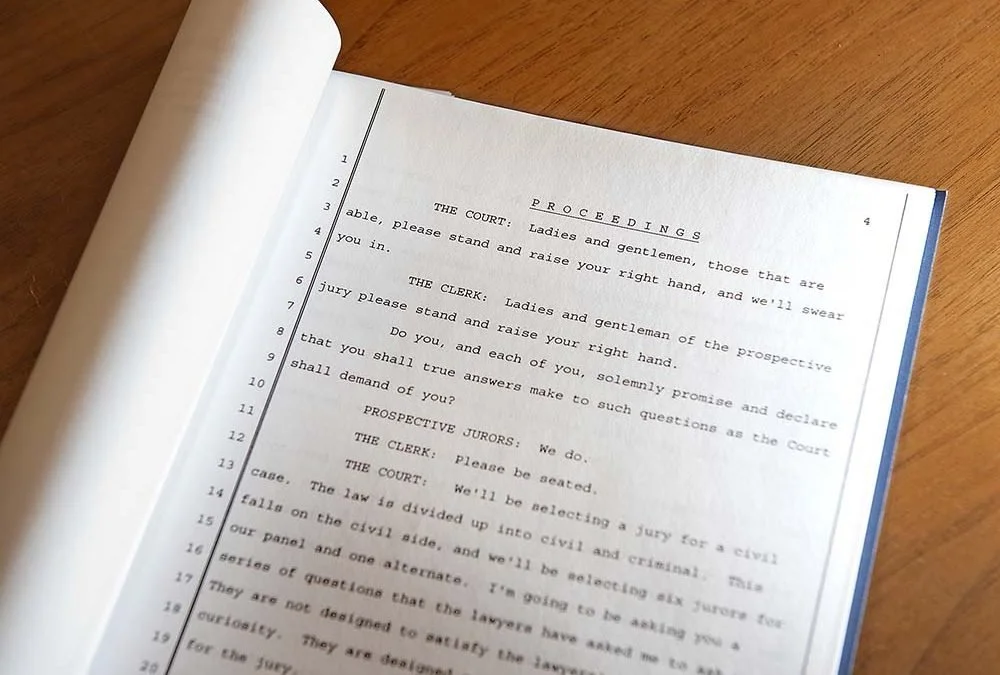
“When I review court transcripts aka the “cold records,” I am not reading for guilty vs not guilty.
I am reading for fairness.
I am looking for the moments when the process failed the promise of justice.
What Do the 2025 Exoneration Numbers Show?
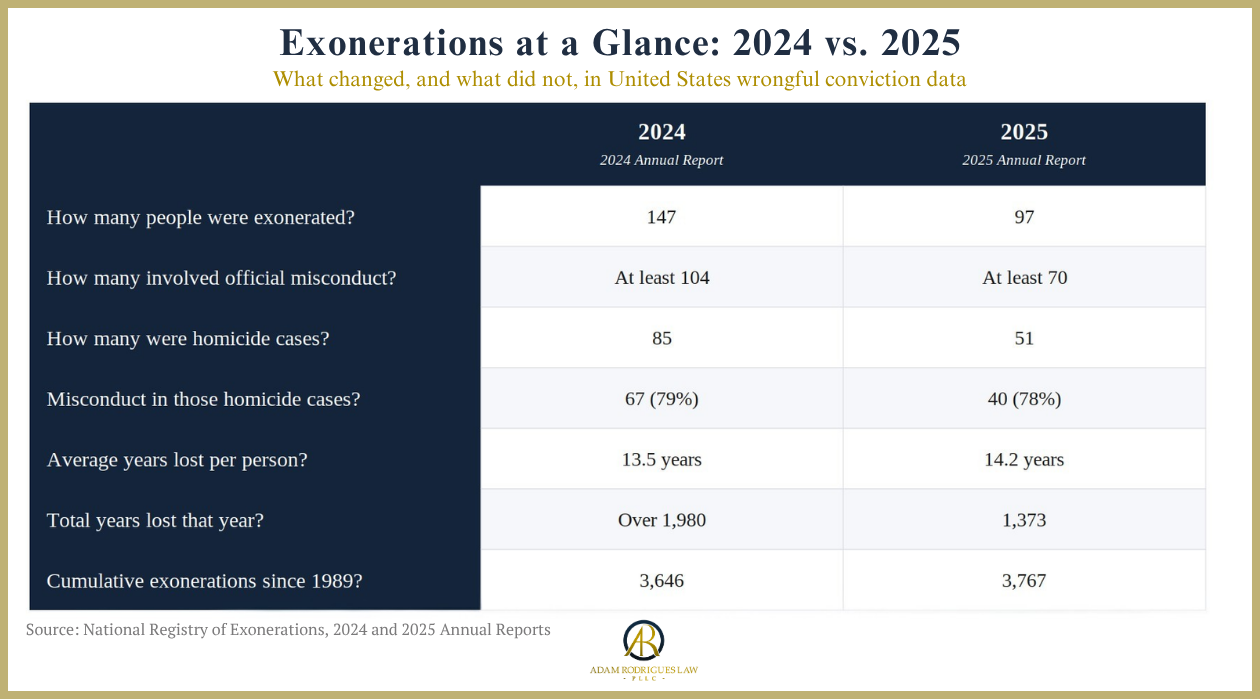
Unfortunately, the reality is that fewer people were exonerated in 2025 than in 2024. The National Registry of Exonerations recorded 97 exonerations in 2025, down from 147 the year before, bringing the total since 1989 to 3,767. A falling count does not mean fewer wrongful convictions happened, though. It means fewer of them were caught, and catching one only happens when somebody goes back through the record.
The rest held steady in the worst possible way. Official misconduct turned up in at least 70 of those 97 cases, and in 40 of the 51 homicide exonerations, which is 78 percent and essentially unchanged from the year before. Across the Innocence Project's DNA exoneration cases the causes overlap heavily: mistaken eyewitness identification in 62 percent, misapplied forensic science in 52 percent, false confessions in 29 percent, informants in 19 percent.
The cost is what stands out: an average of 14.2 years lost per person exonerated in 2025, and 1,373 years among them, from a single year of cases.
Can You Still Challenge a Conviction After Pleading Guilty?
Most people assume a guilty plea closes the door for good, though the Supreme Court has repeatedly held otherwise. In Class v. United States, 583 U.S. (2018), the Court confirmed that a guilty plea does not bar a defendant from later raising a constitutional challenge to the charge itself. Most criminal cases end in a plea rather than a trial, so this is not a narrow exception; it is where most post-conviction work actually happens.
Two other decisions matter just as much here. Under Hill v. Lockhart, 474 U.S. 52 (1985), the Strickland v. Washington test for ineffective assistance of counsel applies to plea advice, so a lawyer who misadvises you about what a plea will cost you can be the basis for relief. And under Garza v. Idaho, 586 U.S (2019), when a lawyer ignores a client's instruction to file an appeal, prejudice is presumed even where the plea agreement contained an appeal waiver.
Key Takeaway: Pleading guilty waives the trial, not the Constitution. Whether a specific claim survives depends on the plea's terms and the deadline that applies in your jurisdiction, which is worth confirming quickly rather than assuming.
What Does a Post-Conviction Attorney Actually Do?
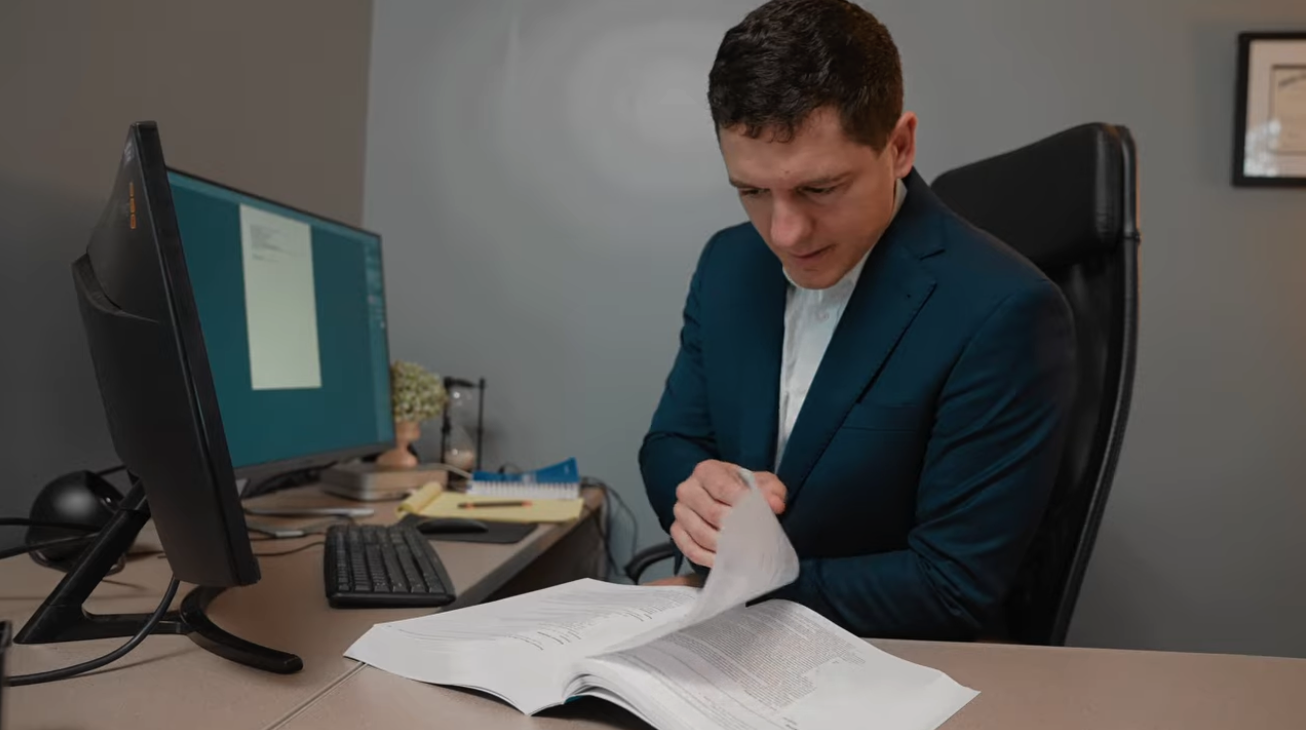
The work is closer to forensic accounting than to courtroom argument, since it means reading a closed record looking for the place the process broke. In practice that means reviewing the trial transcript and appellate record for constitutional error, investigating ineffective assistance or newly discovered evidence, challenging a sentence that exceeds what the law allows, and filing within the deadline that governs the case in federal, Tennessee, or North Carolina court.
Sometimes what surfaces is evidence the defense never saw. Under Brady v. Maryland, 373 U.S. 83 (1963), the prosecution's suppression of evidence favorable to the accused violates due process whether or not it was deliberate. That is close to what happened to Brian Boles and Charles Collins, two men exonerated in New York in 2024 after more than 30 years in prison, where a post-conviction review finally turned up suppressed evidence, false statements, and police misconduct that had never been disclosed at trial.
Scale is why this keeps mattering. With nearly 2 million people behind bars and roughly 5.6 million more under correctional control, according to the Prison Policy Initiative, even a small error rate leaves a great many people holding a real claim that nobody is reviewing.
What This Means for You: If your case had a suppressed report, a lawyer who never investigated, or a sentence that does not match the statute, those are reviewable questions rather than matters of opinion, and they have deadlines attached.
Guilty or not you deserve a post conviction review.
The clock on post-conviction relief runs from the date your conviction became final, and it is usually shorter than people expect. Gathering the record early is what makes a real evaluation possible.
For specific guidance on your or your loved one’s case, call Adam Rodrigues Law 615-270-2074 now (monitored 24/7 by a real human) or schedule a private consultation instantly.
FAQs
-
Most of the time, lawyers don’t actually know whether a client is guilty. In post-conviction work, our focus is not on guilt or innocence but on whether the conviction and sentence were obtained lawfully. By the time our office becomes involved, the trial has already ended.
Our team reviews the record for constitutional errors, unfair procedures, or new evidence that could change the outcome. The goal is to ensure every conviction rests on a fair and legal foundation.
-
Often Yes. Often yes, because a guilty plea waives the trial rather than the Constitution. In Class v. United States, 583 U.S. (2018) the Supreme Court held that pleading guilty does not bar a later constitutional challenge to the charge itself, and in Garza v. Idaho, 586 U.S. (2019) it held that prejudice is presumed when a lawyer ignores a client's instruction to file an appeal, even where the plea contained an appeal waiver. What survives depends on the plea's specific terms and on the deadline that applies in your jurisdiction.
Our office helps clients navigate those appeals and post-conviction petitions to correct legal errors and restore fairness.
-
A direct appeal challenges errors visible on the face of the trial record, such as a wrong jury instruction or an improper evidentiary ruling, and it runs on a short deadline after sentencing.
A direct appeal challenges errors visible on the face of the trial record, such as a wrong jury instruction or an improper evidentiary ruling, and it runs on a short deadline after sentencing. Post-conviction relief comes later and reaches claims that depend on facts outside that record, including ineffective assistance of counsel, newly discovered evidence, and evidence the prosecution never disclosed. The order matters, since post-conviction courts routinely refuse to hear a claim that could have been raised on direct appeal and was not.
Both are essential vehicles that allow our team to hold the system accountable when justice goes wrong.
-
Federal courts and Tennessee both use a one-year clock, though they start it differently. Under 28 U.S.C. § 2255(f), a federal motion must be filed within one year, running from the latest of several trigger dates including the date the conviction became final. Tennessee allows one year under Tenn. Code Ann. § 40-30-102(a), measured from the final action of the highest state appellate court to hear the appeal, or from the date the judgment became final if no appeal was taken. North Carolina's motion for appropriate relief runs on its own limits, so confirm the deadline that governs your case rather than assuming one of these applies.
-
No. Nothing prevents filing on your own, and some people do. The risk is that these claims are technical and the deadlines are unforgiving, so a first petition that omits a claim or pleads it badly can bar a stronger version of the same claim later. That is why an evaluation before filing usually matters more than filing fast. Every case turns on its own record, which is exactly what a consultation is for.
Our team reviews trial transcripts, motions, and evidence to identify mistakes or violations of constitutional rights. We file motions, prepare legal briefs, and argue in appellate courts to correct those errors.
We work tirelessly on our clients behalf to make sure justice was done and the law was followed.
Last Updated: September 21, 2026
Related Articles & Resources
Related Posts:
Ineffective Assistance of Counsel: 6 Trial Errors That Win Post-Conviction Cases - the specific failures that succeed most often
Case Study: Post-Conviction Breakthrough Frees Client 39 Months Early - what the process looks like start to finish
The 2026 Post-Conviction Relief Update - current deadlines in federal, Tennessee, and North Carolina courts
Practice Areas:
Criminal Appeals - direct appeals in federal and state court
Post-Conviction Relief - claims that reach outside the trial record
Habeas Corpus - federal review of a state conviction
Compassionate Release - sentence reduction for extraordinary circumstances
Clemency & Pardons - executive relief after the courts are done