
Federal Habeas vs. State Post-Conviction: Which Relief Path Gets Results Faster?

A Guide Sequencing Your Case in Federal, Tennessee, and North Carolina Courts
Two doors. One clock. Federal habeas corpus and state post-conviction relief both promise a second look at your conviction, but picking the wrong one first can cost you a year you cannot get back.
We hear some version of this question almost every week: is habeas corpus my fastest option? People search for “habeas corpus” (Latin for “that you have the body,” the legal action used to challenge whether a person’s imprisonment or detention is lawful) more than almost any other term related to my practice, and some of them land on the wrong assumption before they even meet with us. They think federal court is the power move, the place a case finally gets taken seriously, however, in practice, it is usually the slower door, and in nearly every case you cannot walk through it until you have already walked through the state door first. This post breaks down what federal habeas corpus actually is under 28 U.S.C. § 2254 or 28 U.S.C. § 2255, what state post-conviction relief is in Tennessee and North Carolina, how the two relate to each other, which one actually resolves faster, and how to choose the right starting point so you do not burn a filing deadline on the wrong petition.
TL;DR
Two systems, not one: federal habeas (28 U.S.C. § 2254/§ 2255) and state post-conviction relief are separate proceedings with separate courts and clocks.
State goes first: federal law requires exhausting state remedies before habeas review (28 U.S.C. § 2254(b)).
Federal clock is unforgiving: one year from final judgment; final meaning once all appeals and/or state remedies and appeals are exhausted.
State deadlines vary: Tennessee gives one year, almost no exceptions. North Carolina now allows up to seven years for non-capital cases.
Federal habeas rarely wins unfortunately: roughly only 1% of non-capital petitions succeed.
First step: find out if your claim has ever reached a state court. If not, start there.
What Is Federal Habeas Corpus, and What Is State Post-Conviction Relief?
Federal habeas corpus is a request to a federal court to review whether your state or federal conviction violated the U.S. Constitution. For someone convicted in state court, that request is filed under 28 U.S.C. § 2254, which allows a federal district court to grant relief to a person “in custody pursuant to the judgment of a State court” if that custody violates federal constitutional rights. For someone convicted in federal court, the equivalent vehicle is a motion under 28 U.S.C. § 2255 to vacate, set aside, or correct the sentence. Both are filed in federal district court, not the court that convicted you, and both are reviewed under a standard that gives heavy deference to the original state or federal court’s rulings.
State post-conviction relief is the state-court version of the same idea, and it is where almost every case has to start. In Tennessee, this is governed by the Post-Conviction Procedure Act,Tenn. Code Ann. § 40-30-101 et seq., filed in the same trial court that entered your judgment. In North Carolina, the vehicle is a Motion for Appropriate Relief (MAR) under N.C. Gen. Stat. § 15A-1415, also filed in the sentencing court. Neither of these is an appeal, which only challenges errors visible in the existing trial record. Post-conviction relief and federal habeas, by contrast, both let you raise claims that could not have been raised on direct appeal, most commonly ineffective assistance of counsel, prosecutorial misconduct that was concealed at trial, or newly discovered evidence.
Appellate courts ask three core questions:
Was the sentence legal? Did the court use the right statute, the right guideline range, and the right enhancements?
Was the procedure correct? Did the judge calculate the guidelines, consider the required factors, and explain the sentence on the record?
Was the sentence substantively reasonable? Even with the right math and procedure, is the length defensible given the offense and the person?

Attorney Insight:
Clients often draft their own federal or state post conviction petitions, or file on their own behalf before reaching out to me. They often do this trying to hurry the process along. With how hard post conviction cases are to win, one of the best pieces of advice I can give is if you want to move quickly, move quickly by speaking with an attorney as soon as you can, before drafting or filing anything.
Claims that typically belong in this second-look process include a lawyer who never investigated an alibi, a prosecutor who withheld exculpatory evidence, a juror who lied during selection, or a guilty plea entered on bad legal advice. Claims that do not belong here, however, are ones already fully litigated and rejected on direct appeal, or ones that amount to disagreement with a judge’s discretionary call rather than a constitutional violation.
One more wrinkle applies federally and in North Carolina. Even after a federal district court rules on a habeas petition, you generally cannot appeal that ruling to a circuit court without a certificate of appealability (COA), a document confirming that at least one judge has agreed your claim raises a serious constitutional question worth a second look, under 28 U.S.C. § 2253, which requires a “substantial showing of the denial of a constitutional right.” The same hurdle also applies in North Carolina; you have to file a petition with either the North Carolina Court of Appeals, or the county Superior Court (depending on if your MAR was denied in Superior or District Court) convincing the higher court your case deserves a second look. State post-conviction appeals in Tennessee do not carry that extra gatekeeping step.
What this means for you: Before you decide which door to walk through, you need to know which court, if any, has already ruled on your specific claim. That answer determines everything downstream, including your deadline.
How Do Federal, Tennessee, and North Carolina Courts Handle These Claims?
Jurisdiction changes almost everything about your deadline, and getting the sequence wrong is likely the most common way people lose a valid claim without ever getting a hearing on the merits.
Here is how each system actually works:
Federal: exhaustion first, then a narrow constitutional review
Federal courts will not touch your claim until state courts have had a full and fair chance to rule on it. Under 28 U.S.C. § 2254(b), a federal habeas petition “shall not be granted” unless the applicant has exhausted state remedies, and the Supreme Court made clear in O’Sullivan v. Boerckel, 526 U.S. 838 (1999), that exhaustion requires one complete round of the state’s established review process, including discretionary review where that exists. Miss a level of state review, and a federal court can treat the claim as unexhausted, or worse, as procedurally defaulted if the state court door has since closed. Even once you finally get to federal court, though, review is not a fresh look at the facts. Under AEDPA, the Antiterrorism and Effective Death Penalty Act of 1996, which is the federal law that overhauled habeas procedure, a federal court can only grant relief if the state court’s decision was contrary to, or an unreasonable application of, clearly established federal law, a narrow, deferential standard rather than a rehearing.
Tennessee: one year, almost no exceptions, on a fast internal clock
Tennessee gives you exactly one year from the date your conviction became final, and the statute says that clock does not stop for anything. Under Tenn. Code Ann. § 40-30-102, the one-year limitations period is not tolled for any reason, with only three narrow statutory exceptions: a new constitutional rule applied retroactively, newly discovered evidence of actual innocence, or a prior conviction used to enhance your sentence later held invalid. Once a petition survives initial review, Tenn. Code Ann. § 40-30-109 requires the trial court to rule on dismissal or set a hearing within 30 days of the state’s response, and to hold that evidentiary hearing within four calendar months of the order setting it. That is a genuinely fast internal clock once a case is moving, but the one-year filing deadline in front of it is unforgiving.
North Carolina: a longer runway, but new limits just took effect
North Carolina gives non-capital cases far more time to file than Tennessee does, but that runway recently got shorter. Under N.C. Gen. Stat. § 15A-1415, a defendant raises post-conviction claims through a Motion for Appropriate Relief (MAR), North Carolina’s name for its post-conviction petition, filed in the original sentencing court. For judgments entered on or after December 1, 2025, non-capital MARs are now subject to a seven-year filing limit under N.C. Gen. Stat. § 15A-1415, with exceptions for newly discovered evidence, good cause, a fundamental miscarriage of justice, or prosecutorial consent. Capital cases move on a different, tighter schedule: a defendant generally has 120 days from the triggering event to file, and the statute requires the court to hold a hearing within 24 months of filing absent a written finding of extraordinary circumstances.
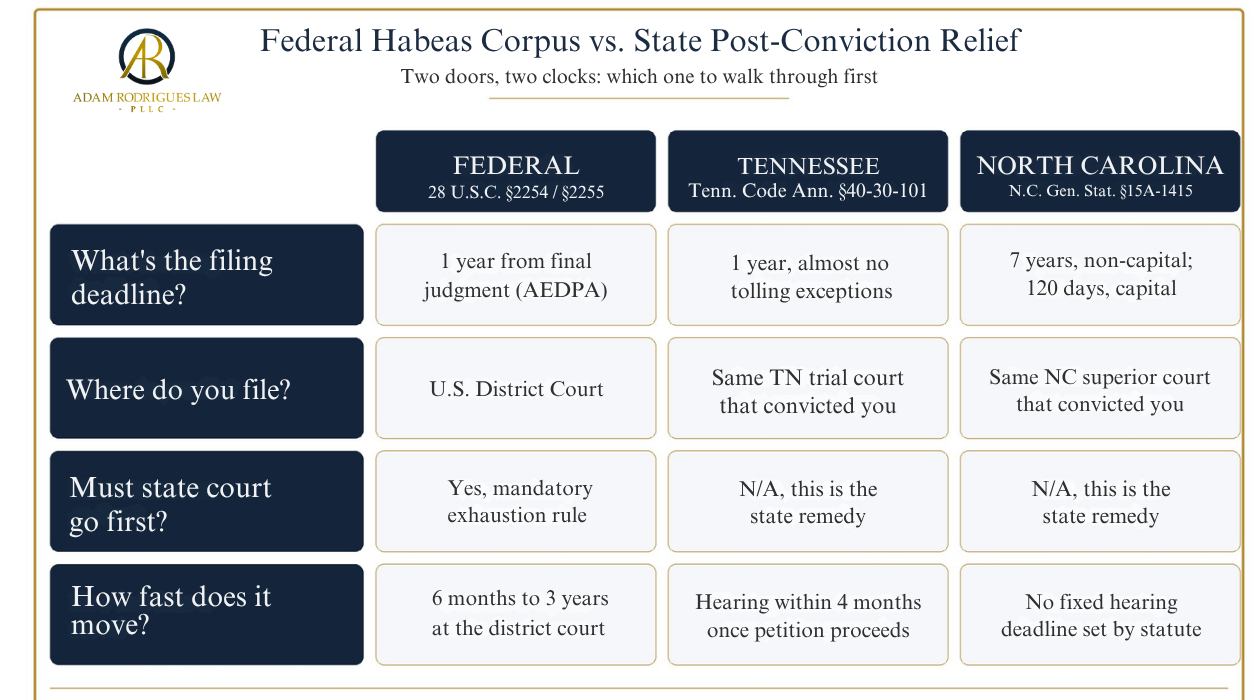
Comparison of federal habeas corpus under 28 U.S.C. §§ 2254–2255, Tennessee post-conviction relief under Tenn. Code Ann. § 40-30-102, and North Carolina's Motion for Appropriate Relief under N.C. Gen. Stat. § 15A-1415.
Key Takeaway: The federal clock and the Tennessee clock both run out in a single year with almost zero room for error. And while North Carolina’s non-capital window is now measured in years, not months, that does not mean it is safe to wait. Every extra month you sit on a claim is a month a witness’s memory fades or evidence disappears.
Success Rates: What the Numbers Actually Show
Federal habeas carries more weight in the public imagination than state post-conviction relief does, but the numbers tell a different story. For most ordinary claims, a state petition gives you a meaningfully better shot at relief than a federal habeas case ever will.
Unfortunately, federal habeas relief is rare. A Department of Justice study found that only about 3.2% of federal habeas petitions filed by state prisoners were granted in whole or in part, and just 1.8% resulted in any form of release, according to the Bureau of Justice Statistics. More recent tallies put the denial rate even higher, with roughly 99.6% of the 16,000 to 18,000 state-prisoner habeas petitions filed each year ultimately denied. Procedural grounds account for a large share of those losses: roughly 57% of habeas claims dismissed on procedural grounds in one BJS study were dismissed specifically for failure to exhaust state remedies, meaning the claim never even reached a merits review.
Attorney Insight: Clients often assume federal court is the stronger move because it feels more serious. However in practice, the odds of winning on the merits there are low, and most of the petitions that get denied never even reach a merits review because of a procedural misstep along the way.
What happens if some claims are exhausted and some are not?
If your petition mixes claims a state court has already ruled on with claims it has not, a federal court generally cannot rule on any of it yet. The Supreme Court addressed this in Rhines v. Weber, 544 U.S. 269 (2005), holding that a district court has limited discretion to stay a “mixed petition” and hold it in abeyance while the petitioner returns to state court on the unexhausted claims, but only where there was good cause for the failure to exhaust, the unexhausted claims are potentially meritorious, and the petitioner has not been intentionally delaying. That stay-and-abeyance option exists precisely because AEDPA’s one-year clock is unforgiving. Miss it while shuttling between courts, and you can lose the claim entirely. Separately, if you defaulted a claim in state court, for example by missing a state filing deadline or failing to raise it at the required stage, Coleman v. Thompson, 501 U.S. 722 (1991), generally bars a federal court from hearing it too, absent a showing of cause and prejudice or a fundamental miscarriage of justice.
What this means for you: the most reliable path in nearly every case is to get your strongest claims in front of the state court first, on time, and let the federal habeas clock run in the background while that state case is properly pending. Racing to federal court first rarely works and can make things worse.

Client Success Story
After other lawyers had deemed the case hopeless, Attorney Adam Rodrigues discovered an original judge sentencing miscalculation that ultimately saved his client, Cordario DeBose, 39 months in prison.
Choosing the Right Path for Your Case
Every week that passes without a filing is a week you cannot get back, and the deadlines here do not bend for good intentions. If you are trying to figure out where to start, the honest answer for most people is state court first: Tennessee’s Post-Conviction Procedure Act or North Carolina’s Motion for Appropriate Relief, depending on where you were convicted, with a federal habeas petition held in reserve for after state review is complete or genuinely unavailable.
What Sets a Successful Claim Apart, in Any Court
The same habits separate strong petitions from weak ones, whether you end up in Tennessee, North Carolina, or federal court. A claim tends to hold up when it is well-documented and ready to file quickly, when it rests on evidence no court has seen yet, and when it is filed within the deadline.
Immediate actions:
Confirm the exact date your conviction became final on direct appeal, since every deadline runs from that date.
Determine whether your claim has ever been presented to, and ruled on by, a state court.
Gather affidavits, records, or other evidence now, before memories fade or documents go missing.
Build a written timeline of your case from arrest through today.
Contact experience post-conviction legal counsel before you file anything, especially if you are close to a one-year deadline in Tennessee or federal court.
Weighing your options post-conviction strategy alone?
Sequencing a habeas and post-conviction strategy correctly is one of the most consequential judgment calls in this area of law, and it is exactly the kind of decision that benefits from experienced legal counsel like Adam Rodrigues Law rather than a form pulled from a prison law library.
For a sense of what a well-sequenced post-conviction strategy can do for your life or a family members’s life see our related case study on a recent client’s early release.
Call Adam Rodrigues Law 615-270-2074 now or book your private consultation today and we can give you specific guidance for your case today.
FAQs
-
No. A direct appeal challenges errors visible in the existing trial record and is decided by the state’s appellate courts shortly after conviction. Habeas corpus (Latin for “that you have the body,” the proceeding used to test whether a detention is lawful) is a separate federal proceeding, filed under 28 U.S.C. § 2254 or § 2255, that reviews whether your custody violates the U.S. Constitution, and it typically comes after both a direct appeal and state post-conviction relief have already run their course.
-
Yes. Under 28 U.S.C. § 2254(b), a federal court cannot grant habeas relief to a state prisoner unless state remedies have been exhausted, and the Supreme Court held in O’Sullivan v. Boerckel, 526 U.S. 838 (1999), that this means completing one full round of the state’s review process. Filing directly in federal court without state review first is one of the most common reasons habeas petitions get dismissed rather than decided.
-
Federal habeas at the district court level alone typically takes anywhere from six months to two or three years, with no statutory clock for non-capital cases. Tennessee’s post-conviction process moves faster once a petition survives initial review, with a hearing required within four months of the court’s order under Tenn. Code Ann. § 40-30-109. North Carolina’s Motion for Appropriate Relief has no fixed hearing deadline in non-capital cases, though the filing window itself now runs up to seven years for judgments entered on or after December 1, 2025.
-
Not usually, and not safely without planning. Federal courts generally will not rule on unexhausted claims, and a “mixed petition” containing both exhausted and unexhausted claims can be stayed and held in abeyance under Rhines v. Weber, 544 U.S. 269 (2005), but only in limited circumstances. The more reliable approach is to file in state court first and let the federal one-year clock toll while that petition is properly pending.
-
What happens if I miss the one-year federal deadline?
Missing the one-year deadline set by AEDPA (the Antiterrorism and Effective Death Penalty Act of 1996) under 28 U.S.C. § 2244(d)(1) can permanently bar federal habeas review of your claim, subject only to narrow exceptions like equitable tolling, which requires showing diligence and an extraordinary circumstance, or a credible actual-innocence gateway claim. Courts do not treat this deadline casually, and a late filing by even a few days can result in dismissal without any review of the merits.
-
Usually yes, and this is the normal, correct sequence rather than a backup plan. Once you have exhausted state remedies, meaning you completed one full round of state review including any available discretionary appeal, you can file a federal habeas petition raising the same claims under 28 U.S.C. § 2254. Keep in mind that the federal one-year clock, though tolled while your state petition was properly pending, keeps running before that filing and after the state case ends, so do not treat a state court denial as a reason to slow down.
Last Updated: July 13, 2026;
Related Blogs & Resources:
Habeas Corpus Explained – a plain-English breakdown of what federal habeas corpus is and when it applies.
Case Study: Post-Conviction Breakthrough Frees Client 39 Months Early – how a properly sequenced post-conviction strategy changed a client’s release date.
Debunking the Top 5 Myths About Post-Conviction Relief – common misconceptions that keep people from filing the right petition on time.
Transparent Federal Post-Conviction Pricing (28 U.S.C. § 2255/2254/2241)