
Constructive Discharge in Tennessee: When "Resign or Be Fired" Is Really a Termination
New Adam Rodrigues Law Victory Changes TN Employment Law Forever.

10 Min. Read
Being told "resign or I will fire you" is not a choice a stay.
Tennessee is an at-will employment state, and employers love to treat that as a free pass: quit or be fired, and either way you walk out with no claim. A new published decision from the Tennessee Court of Appeals, won by Adam Rodrigues Law, pushes back on that.
The case started when a decorated Nashville paramedic refused to force medical treatment on a jail inmate who had clearly said no, documented what happened, and was then told to resign or be fired. He resigned, then sued. In Adam Thomas v. Metropolitan Government of Nashville and Davidson County, the court held that a "resign or be fired" ultimatum can count as a firing under Tennessee's whistleblower law.
Below is what the court actually decided, how it applies to you, and what to do if you were pushed out for refusing to break the law.
TL;DR
"Resign or be fired" is not really quitting. If your employer made the decision to end your job, Tennessee law can treat that forced resignation as a firing. The legal name for it is constructive discharge.
It only matters if the firing would be illegal. Tennessee is an at-will state, so being pushed out gives you a claim only when the real reason is illegal, like discrimination, retaliation, or whistleblowing.
A new win by Adam Rodrigues Law makes this clear for whistleblowers. In Adam Thomas v. Metro Nashville (Tenn. Ct. App. 2026), the court held that a "resign or be fired" ultimatum can count as a discharge under the Tennessee Public Protection Act (TPPA).
Federal courts already agreed. Under the reasonable-employee standard, a credible threat of being fired can turn a resignation into a discharge.
A forced resignation is the start, not the whole case. You still have to prove the underlying claim, and for a whistleblower case the protected activity must be the sole reason for the firing.
If you were pushed out, you may still have a case. A forced resignation can still count as a discharge, so do not assume that resigning ended your rights. Document everything and call 615-270-2074 Adam Rodrigues TN employment lawyer before the deadline runs out.
What Did the Court Decide in the Adam Thomas v. Metro Nashville Case?
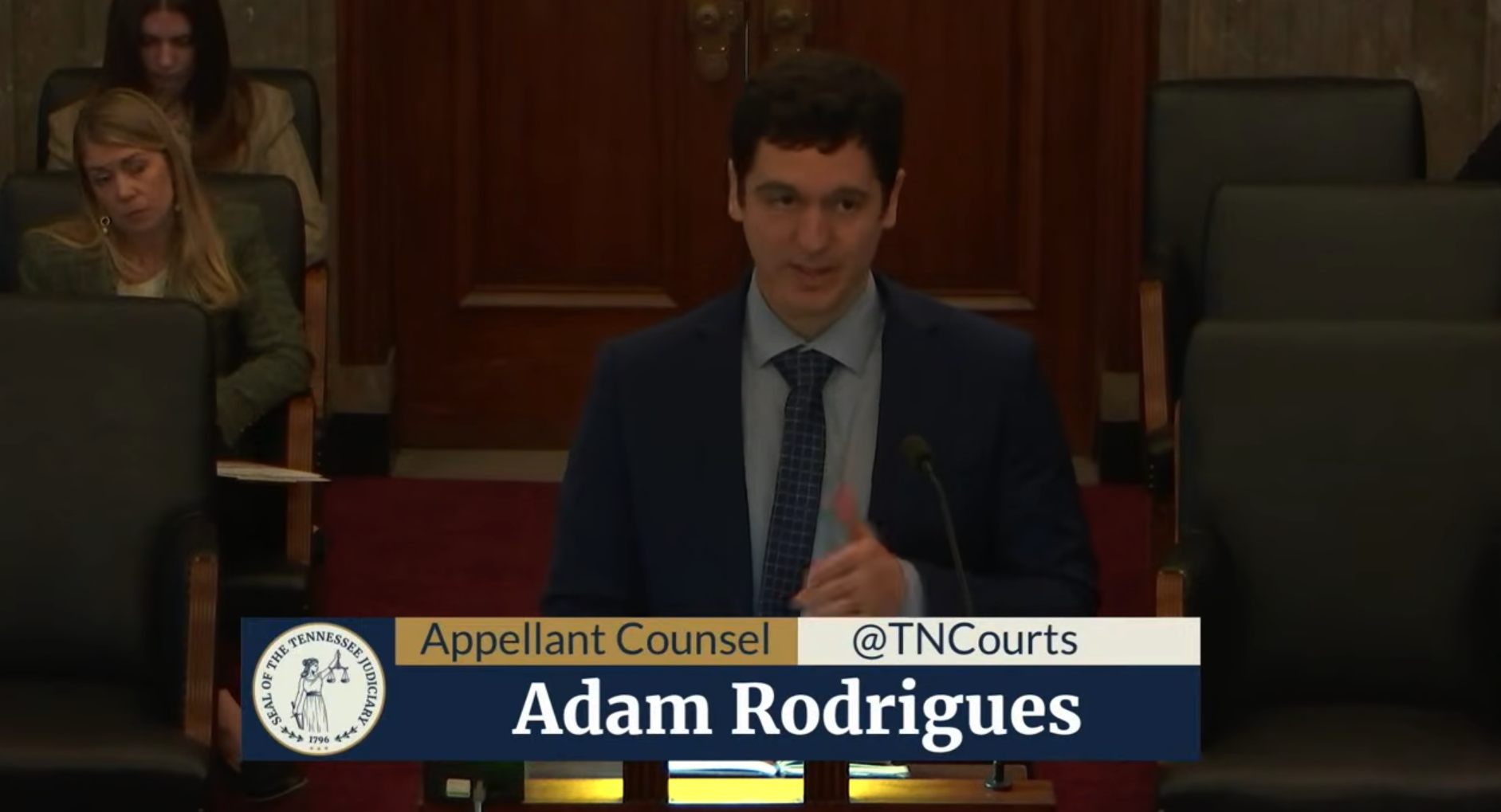
The video below is the recorded oral argument before the Tennessee Court of Appeals, where Adam Rodrigues argued Mr. Thomas's appeal.
Adam Thomas was a Nashville Fire Department paramedic with eight years of experience and three performance awards in his first six months on the job. That record stopped protecting him, according to his complaint, after he refused to force medical treatment on a mentally competent jail inmate who had clearly declined care, and then documented the incident. Mr. Thomas, a former Marine, alleges the situation came to a head when supervisors blocked a coworker from covering his shift so that he could not attend his unit's annual memorial at Arlington National Cemetery for a fellow soldier killed in Afghanistan. Soon after, a fire department chief gave him a choice: resign, or be fired. He resigned, then sued under the Tennessee Public Protection Act, Tenn. Code Ann. § 50-1-304, alleging he had been constructively discharged in retaliation for refusing to participate in an illegal activity.
The trial court dismissed the case on the theory that an employee who resigns has not been discharged. On appeal, argued by Adam Rodrigues Law, the Court of Appeals reversed, holding that the fire department, not Mr. Thomas, decided the employment would end. The decision is now published, citable authority across Tennessee, which is why it reaches well beyond this one paramedic.
It is a public record of the case made to the court, including the argument that a forced resignation leaves an employee no real choice to stay. The threshold question in any forced-resignation case is a narrow one: when an employer makes an employee choose between resigning and being terminated, has the employee quit, or has the employee been discharged? The law resolves that question through a doctrine called constructive discharge, which treats a resignation as a termination when the employer, not the employee, is the party that actually ended the relationship. The doctrine exists for a practical reason. Without it, an employer could avoid liability for an unlawful firing simply by pressuring the employee to sign a resignation letter first. Federal and Tennessee courts both recognize constructive discharge, though they arrive at it along somewhat different paths.
How Do Federal and Tennessee Courts Treat "Resign or Be Fired"?
So whether a forced resignation counts as a firing depends on which law you are using, and federal and Tennessee courts get there by slightly different routes. Constructive discharge is a doctrine courts created to stop employers from dodging liability by making someone quit instead of firing them. As the Tennessee Supreme Court put it in Lemon v. Williamson County Schools, "the whole point of the doctrine of constructive discharge is to legally regard a resignation as a firing rather than a voluntary quit." That principle is the common thread, and the application differs between federal and Tennessee law.
Federal: a reasonable-employee standard

A resignation signed under a "resign or be fired" ultimatum may still be a discharge under Tenn. Code Ann. § 50-1-304, because the employer, not the employee, decided to end the job.
Federal courts have long held that a credible threat of termination can convert a resignation into a discharge. The question is whether a reasonable employee, faced with the employer's conduct, would have understood that termination was imminent.
The Sixth Circuit, whose decisions govern federal courts in Tennessee, articulated the rule in Laster v. City of Kalamazoo: when an employer communicates to a reasonable employee that she will be terminated and she resigns, the conduct "may amount to constructive discharge," because "the handwriting was on the wall and the axe was about to fall." Federal discrimination and retaliation statutes like Title VII of the Civil Rights Act of 1964 and the Americans with Disabilities Act (ADA) use this reasonable-employee test, asking whether a reasonable person would have felt they had no real choice but to quit.
What this means for you: the label on the exit paperwork does not control. What matters is whether the employer had already decided to end the employment and made that decision clear.
Tennessee: now squarely inside the Public Protection Act
After Thomas, a forced resignation can satisfy the discharge requirement of the Tennessee Public Protection Act (TPPA), the state's whistleblower statute. Tennessee had previously construed the operative terms narrowly. In Harman v. University of Tennessee, the Tennessee Supreme Court held that the words "discharged" and "terminated" require "a complete severance of the employment relationship" and "an act on the part of the employer to end the employment relationship." The defendant in Thomas relied on that language to argue that an employee who resigns can never satisfy the statute.
The Court of Appeals rejected that reading. The employer's resign-or-be-terminated ultimatum was itself the act that severed the relationship, and the employee retained no genuine choice in the matter. The court also drew on Lemon, in which the Tennessee Supreme Court explained that constructive discharge "sits comfortably alongside the discrimination and retaliatory discharge statutes; it facilitates rather than frustrates the aims of those statutes." Because the TPPA is a retaliatory discharge statute, the doctrine fits within it. Tennessee had already defined the terms strictly. In Harman v. University of Tennessee, the Supreme Court said "discharged" and "terminated" require "a complete severance of the employment relationship" and "an act on the part of the employer to end the employment relationship." Metro used that language to argue that a resignation can never qualify.
The Court of Appeals read Harman the other way. The fire department's ultimatum was the employer's act that completely severed the relationship. And drawing on Lemon, the court explained that constructive discharge "sits comfortably alongside the discrimination and retaliatory discharge statutes; it facilitates rather than frustrates the aims of those statutes." The TPPA is a retaliatory discharge statute, so the doctrine fits.
What this means for you: Whether your case proceeds under federal law or the Tennessee Public Protection Act, a resignation extracted under a threat of termination is not, by itself, fatal to your claim. The standard for establishing a forced resignation is similar under both, but the statute you proceed under, the filing deadline, and the elements you must prove are not. Identifying the correct legal theory at the outset has a direct effect on the strength of the claim.
Key Takeaway: A forced resignation can constitute a discharge under both federal and Tennessee law, but the governing statute and the applicable deadline are different. The legal theory should be selected, and the claim filed, before the limitations period expires.
What Must a Tennessee Whistleblower Prove Under the TPPA?
Establishing that a forced resignation qualifies as a discharge clears only the first hurdle. A claim under the TPPA has several elements, and each must be satisfied. The statute provides that no employee shall be "discharged or terminated solely for refusing to participate in, or for refusing to remain silent about, illegal activities." Thomas addressed three of the more demanding elements, set out below.
Requirement #1: refusing to participate in, or report, an illegal activity
The conduct you opposed must qualify as an "illegal activity," a term the statute defines, rather than conduct you merely found objectionable. The TPPA defines illegal activities as actions "in violation of the criminal or civil code of this state or the United States or any regulation intended to protect the public health, safety, or welfare." Tenn. Code Ann. § 50-1-304(a)(3)(A). In ordinary terms, the conduct has to break an actual law or safety regulation, not simply a company policy or a management decision you considered unfair.
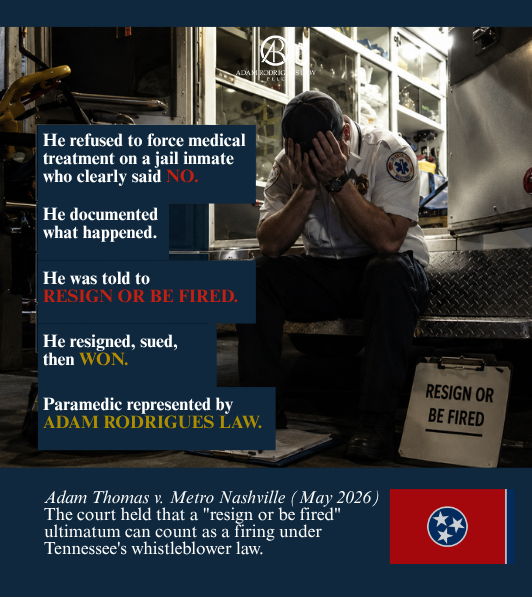
Landmark Tennessee whistleblower decision: In Adam Thomas v. Metropolitan Government of Nashville and Davidson County, the Tennessee Court of Appeals held that a "resign or be fired" ultimatum can qualify as a discharge under the Tennessee Public Protection Act, allowing the employee's retaliation claim to proceed.
In Thomas, the alleged illegal activity was the forced medical treatment of a mentally competent inmate who had refused care, conduct that implicates a patient's recognized right to refuse treatment, an issue the court noted by reference to San Juan-Torregosa v. Garcia. The defendant did not dispute that forced treatment is unlawful. It argued instead that the paramedic had not himself participated, because he was only providing transport. The court was unpersuaded, reasoning that refusing to facilitate an unlawful act is itself protected, and that a paramedic who monitors a patient's vital signs is rendering medical care regardless of the "transport" label.
Where the requirement is typically met:
You declined to perform an act that would violate a statute, code, or safety regulation.
You reported conduct that breaks the law, not merely an internal rule.
You can identify the specific law or regulation at issue.
Your refusal or report aligns in time with the adverse action that followed.
Where it typically fails:
The conduct you opposed was lawful, even if it was unpopular or poorly handled.
You objected to a management decision that violated no law.
No statute or regulation can be identified.
Requirement #2: Reporting to Someone Other Than the Wrongdoer
Reporting the conduct only to the person responsible for it does not satisfy the statute. This is the element that defeats many otherwise viable claims. In Haynes v. Formac Stables, the Tennessee Supreme Court held that an employee who reports wrongdoing solely to the wrongdoer, even where that person is the owner, has not "blown the whistle" in any meaningful sense, because the misconduct was never actually exposed to anyone in a position to address it.
Reporting that typically qualifies:
You raised the issue with someone outside the group responsible, such as a separate department, an outside agency, or law enforcement.
You documented the violation in a record that reached beyond the wrongdoers.
You refused to participate at all, which is protected independently of any report.
Reporting that typically fails:
You complained only to the supervisor directing the unlawful conduct.
You raised it solely with the owner or manager who was the wrongdoer.
In Thomas, the element was satisfied because the paramedic reported the violation to individuals outside the fire department, including the treating physician, hospital nurses, and the inmate himself, and then documented it. The court treated the question of precisely who within the department counted as a "wrongdoer" as an interesting one, but unnecessary to resolve at the motion-to-dismiss stage.
Requirement #3: The "Sole Reason" Causation Standard
Tennessee imposes a demanding causation standard: the protected activity must be the sole reason for the termination. A 2014 amendment to the TPPA requires the employee to prove that the protected conduct was the "sole reason" for the discharge, a higher bar than the common-law standard, which asks only whether the conduct was a "substantial factor." If the employer can establish a genuine, independent reason for the termination, the statutory claim becomes considerably harder to sustain.
Causation is ordinarily proven through circumstantial evidence. In Williams v. City of Burns, the Tennessee Supreme Court treated close timing, a previously unblemished record, and a sudden increase in scrutiny after the protected conduct as evidence of retaliation. The allegations in Thomas follow that pattern: an award-winning paramedic, a refusal to participate in unlawful conduct, an extensive reprimand for documenting it, and a resignation ultimatum weeks later, while a comparable employee who missed a shift received only a written warning.
Attorney Insight: The "sole reason" standard is why these cases are won or lost on the timeline. When a strong performer is pushed out immediately after refusing an unlawful instruction, and a comparable coworker faced a minor consequence for the same conduct the employer now calls fireable, the real reason tends to reveal itself.
What this means for you: A TPPA claim is not a general complaint that you were treated unfairly. It is a specific, documented sequence: the illegal activity, your refusal or your report to someone outside the wrongdoers, the adverse action, and evidence that the protected conduct, and nothing else, caused it. The quality of your documentation determines the strength of each link.
Next Steps: What to Do If You Were Forced to for Refusing to Break the Law
If you were pressured to resign after refusing to participate in or report unlawful conduct, both the evidence and the filing deadline work against you the longer you wait. Memories fade, witnesses move on, and employers update their records, so acting promptly preserves the claim.
Immediate actions:
Prepare a detailed written timeline while the events are fresh: dates, names, what was said, and who was present.
Preserve everything, including emails, text messages, reports you filed, performance reviews, and any resignation or severance documents.
Identify each person to whom you reported the unlawful conduct, particularly anyone outside the group responsible for it.
Note any comparable employees who were treated more leniently for similar conduct.
Do not sign a severance agreement or release of claims without legal review, because those documents often waive your right to sue, which is the step that can actually cost you the claim.
You still have options even if you signed a resignation letter.
As Thomas confirms, a forced resignation does not, by itself, forfeit your claim, so if you have already resigned under a resign-or-be-fired ultimatum, you may still have one. The document to watch is a severance agreement or release of claims, which typically asks you to give up the right to sue in exchange for a payment.
Call Adam Rodrigues Law 615-270-2074 now or instantly book your private consultation today. Our firm evaluates these matters individually and offers transparent pricing so you understand the cost before any work begins.
FAQs
-
It can be. In Adam Thomas v. Metropolitan Government of Nashville, the Tennessee Court of Appeals held that a resign-or-be-fired ultimatum can satisfy the discharge requirement of the Tennessee Public Protection Act, because the employer, not the employee, made the decision to end the employment. The wording of the exit paperwork does not control.
-
It is not limited to whistleblowers, but it is not unlimited either. Constructive discharge applies where it fits the underlying claim, most commonly discrimination and retaliation claims, and now, after Thomas, whistleblower claims under the TPPA. Because Tennessee is an at-will state, a forced resignation only gives you a claim where the termination itself would have been unlawful. If the employer could lawfully have fired you for any reason, forcing you to resign changes nothing.
-
Constructive discharge is a legal doctrine that treats a resignation as a termination when the employer compelled it, either by creating intolerable working conditions or by making clear that the employee would otherwise be fired. As the Tennessee Supreme Court stated in Lemon v. Williamson County Schools, the purpose of the doctrine is "to legally regard a resignation as a firing rather than a voluntary quit."
-
The TPPA, Tenn. Code Ann. § 50-1-304, prohibits an employer from discharging an employee solely for refusing to participate in, or for refusing to remain silent about, illegal activities. The statute defines "illegal activities" as conduct that violates the criminal or civil code, or a regulation intended to protect public health, safety, or welfare.
-
Generally, yes. Under Haynes v. Formac Stables, reporting the misconduct only to the person responsible for it does not qualify, because nothing is actually exposed. Reporting to a separate department, an outside agency, law enforcement, or an affected third party can satisfy the requirement. Refusing to participate in the unlawful conduct is protected on its own, independent of any report.
Last Updated: July 17, 2026
Related Blogs & Resources:
What Does "Employed At Will" Really Mean? - How Tennessee's at-will rule works, and the exceptions that make a termination unlawful.
Can I Sue My Employer in Tennessee? - When Tennessee employees can bring wrongful termination and retaliation claims.
Denied Maternity Leave or a Promotion After Pregnancy? That's Illegal - How pregnancy discrimination and retaliation work under federal and Tennessee law.
Flat-Rate Pricing - Transparent pricing for employment evaluations and consultations.

About the Author
Adam Rodrigues is the lead attorney of Adam Rodrigues Law PLLC, based in Murfreesboro, Tennessee. His practice focuses on post-conviction relief, criminal appeals, and compassionate release matters in Tennessee, North Carolina, and federal courts across multiple districts. He also handles Tennessee employment law matters, including whistleblower and retaliation cases.
Call Adam Rodrigues Law 615-270-2074 now or book your private consultation today.
Quick Case Law References
Adam Thomas v. Metropolitan Government of Nashville & Davidson County (Tenn. Ct. App. May 2026) – Published Tennessee Court of Appeals decision holding that a "resign or be fired" ultimatum can satisfy the discharge requirement under the Tennessee Public Protection Act (TPPA), allowing a whistleblower retaliation claim to proceed. (Primary case discussed in this article.)
Lemon v. Williamson County Schools, 618 S.W.3d 1 (Tenn. 2021) – Tennessee Supreme Court explained that "the whole point of the doctrine of constructive discharge is to legally regard a resignation as a firing rather than a voluntary quit." Supports treating forced resignations as terminations.
Harman v. University of Tennessee, 353 S.W.3d 734 (Tenn. 2011) – Defined "discharged" and "terminated" under the TPPA as requiring a complete severance of the employment relationship and an act by the employer ending that relationship.
Laster v. City of Kalamazoo, 746 F.3d 714 (6th Cir. 2014) – Sixth Circuit held that when an employer communicates that termination is imminent, a resignation may constitute constructive discharge because a reasonable employee would understand that firing is inevitable.
Haynes v. Formac Stables, Inc., 463 S.W.3d 34 (Tenn. 2015) – Tennessee Supreme Court held that reporting wrongdoing only to the wrongdoer is generally insufficient to qualify as whistleblowing under the TPPA.
Williams v. City of Burns, 465 S.W.3d 96 (Tenn. 2015) – Discussed proof of retaliatory motive under the TPPA, recognizing that timing, prior performance history, and disparate treatment can support causation.
San Juan-Torregosa v. Garcia, 80 F.4th 291 (1st Cir. 2023) – Recognized the longstanding legal principle that a competent patient generally has the right to refuse unwanted medical treatment. Cited in Thomas regarding the alleged illegality of forced treatment.