
Compassionate Release After Rutherford and Fernandez: What Still Qualifies in 2026?
How the Supreme Court's May 2026 rulings reshaped federal sentence reductions under 18 U.S.C. § 3582(c)(1)(A)
15 min. Read
The Supreme Court's Rutherford and Fernandez decisions changed how federal courts evaluate compassionate release motions under 18 U.S.C. § 3582(c)(1)(A).
On May 28, 2026, the Supreme Court narrowed federal compassionate release in two decisions. Medical conditions, age, and family hardship still qualify, but a long sentence from an old stacking law no longer does.
If you have a loved one in federal prison and you have been told that compassionate release might be a path home, unfortunately, the ground just shifted a bit. In two rulings issued the same day, Rutherford v. United States and Fernandez v. United States, the Supreme Court closed off two arguments that thousands of motions had relied on. This post explains exactly what changed, what survived, and what to do now.
TL;DR
What the Court did: On May 28, 2026, in Rutherford v. United States and Fernandez v. United States, the Supreme Court narrowed federal compassionate release under 18 U.S.C. § 3582(c)(1)(A).
What is now off the table: A non-retroactive change in sentencing law (such as the First Step Act's end to § 924(c) “stacking”) can no longer be an extraordinary and compelling reason, alone or combined with anything else.
What else is off the table: A claim that you are innocent or that your trial was flawed belongs in a habeas petition under 28 U.S.C. § 2255, not a compassionate release motion.
What still qualifies: Serious medical conditions, terminal illness, advanced age with health decline, and dire family caregiving needs all remain valid grounds.
First action: Submit a written request to the warden, then wait 30 days or get a denial before filing in the sentencing court.
Get help: We work with federal compassionate release cases with flat rate, transparent pricing. Call 615-270-2074 or book a consultation.
Supreme Court’s New Limitations on Federal Compassionate Release
On May 28, 2026, the Supreme Court issued two decisions that cut off the two broadest arguments for compassionate release, while leaving the core medical, age, and family grounds untouched. Compassionate release is the legal tool that lets a federal judge reduce a sentence already imposed when “extraordinary and compelling reasons” make continued imprisonment unjust. It lives in 18 U.S.C. § 3582(c)(1)(A), and since the First Step Act of 2018 an incarcerated person, a family member, or their lawyer can file directly in court after asking the warden first.
The two cases are Rutherford v. United States (No. 24-820) and Fernandez v. United States (No. 24-556). Justice Barrett wrote the lead opinion in each. They were decided together, and together they answer a question that had split the federal appeals courts for years: how far does “extraordinary and compelling” reach?

§ 924(c) "Stacking" After Rutherford (2026): The Supreme Court held that non-retroactive sentencing reforms cannot independently justify compassionate release.
Here is what Rutherford decided. The petitioners were serving long sentences built on “stacked” § 924(c) gun counts, the kind of sentence the First Step Act made illegal going forward but did not undo for people already sentenced. They argued that the gap between their old sentence and what they would get today was itself extraordinary and compelling. The Court said no. A non-retroactive change in the law, standing alone or combined with other factors, cannot be the basis for compassionate release. Unfortunately, if Congress chose not to make a sentencing reform retroactive, a judge cannot use § 3582(c)(1)(A) to do it anyway.
Here is what Fernandez decided. Joe Fernandez argued that lingering doubts about his conviction, the kind of fairness and innocence concerns a sentencing judge might feel, should count as extraordinary and compelling. However, the Court disagreed. A prisoner who is really attacking the validity of his conviction must go through habeas corpus under 28 U.S.C. § 2255. Compassionate release is for changed personal circumstances, not for re-litigating guilt.
What does NOT survive these rulings is just as important as what does. You can no longer win compassionate release by pointing to a sentencing law that changed after you were sentenced, and you can no longer use it as a back door to argue innocence or trial error. The Court also clarified that the U.S. Sentencing Commission's November 2023 policy statement is invalid to the extent it told judges they could treat non-retroactive law changes as a reason for release.
Key points:
Decided May 28, 2026: Rutherford and Fernandez, both under § 3582(c)(1)(A).
Non-retroactive law changes (including old § 924(c) stacking) are out, alone or in combination.
Innocence and trial-error claims belong in § 2255 habeas, not compassionate release.
Medical, age, and family grounds are untouched and remain fully available.
What this means for you: If your loved one's hope rested entirely on “the law changed” or “he is actually innocent,” that specific path through compassionate release is unfortunately, now closed. However, if there is a real medical, age, or family reason, your case is exactly the kind the statute was built for, and it is unaffected. See more details below on what requirements still stand for “extraordinary and compelling reasons.”
What Counts as “Extraordinary and Compelling” After May 2026?
The phrase "extraordinary and compelling reasons" is the heart of federal compassionate release, and the categories that qualify are listed under U.S. Sentencing Commission Guidelines § 1B1.13. After Rutherford and Fernandez, three durable grounds account for most successful compassionate release motions: a serious medical condition under § 1B1.13(b)(1), advanced age with health decline under § 1B1.13(b)(2), and family circumstances, including the sole caregiver provision, under § 1B1.13(b)(3).
Two other categories also survived and are worth knowing: being the victim of sexual or serious physical abuse in custody under § 1B1.13(b)(4), and the catch-all "other reasons" of similar gravity under § 1B1.13(b)(5). The provision Rutherford struck down is § 1B1.13(b)(6), the "unusually long sentence" ground that had let judges treat a non-retroactive change in law as extraordinary and compelling.
Even the strongest cases must satisfy two mandatory requirements: first, the inmate must properly exhaust the Bureau of Prisons process policy by requesting relief from the warden; second, the court must find that the § 3553(a) sentencing factors and public-safety considerations support release.
Requirement 1: A serious medical condition
Medical hardship is still the clearest and strongest ground for compassionate release, and the 2026 rulings left it fully intact. Under US Sentencing Commissions Guidelines § 1B1.13, terminal illness qualifies without any need to prove a precise life expectancy. Examples the Commission gives include metastatic solid-tumor cancer, ALS, end-stage organ disease, and advanced dementia. Serious physical or cognitive conditions that substantially diminish a person's ability to care for themselves in prison, and from which they are not expected to recover, also qualify.
When this works in your favor:
A terminal diagnosis documented by prison or outside physicians.
An advancing illness (ALS, severe heart or kidney failure) that prison medical staff cannot adequately manage.
A debilitating injury or cognitive decline that leaves the person unable to handle daily self-care.
Strong, current medical records that match what the motion claims.
When you will fail this test:
Common, well-managed conditions like controlled diabetes or high blood pressure.
A serious diagnosis with no supporting medical documentation.
General complaints about the quality of prison healthcare without a qualifying condition.
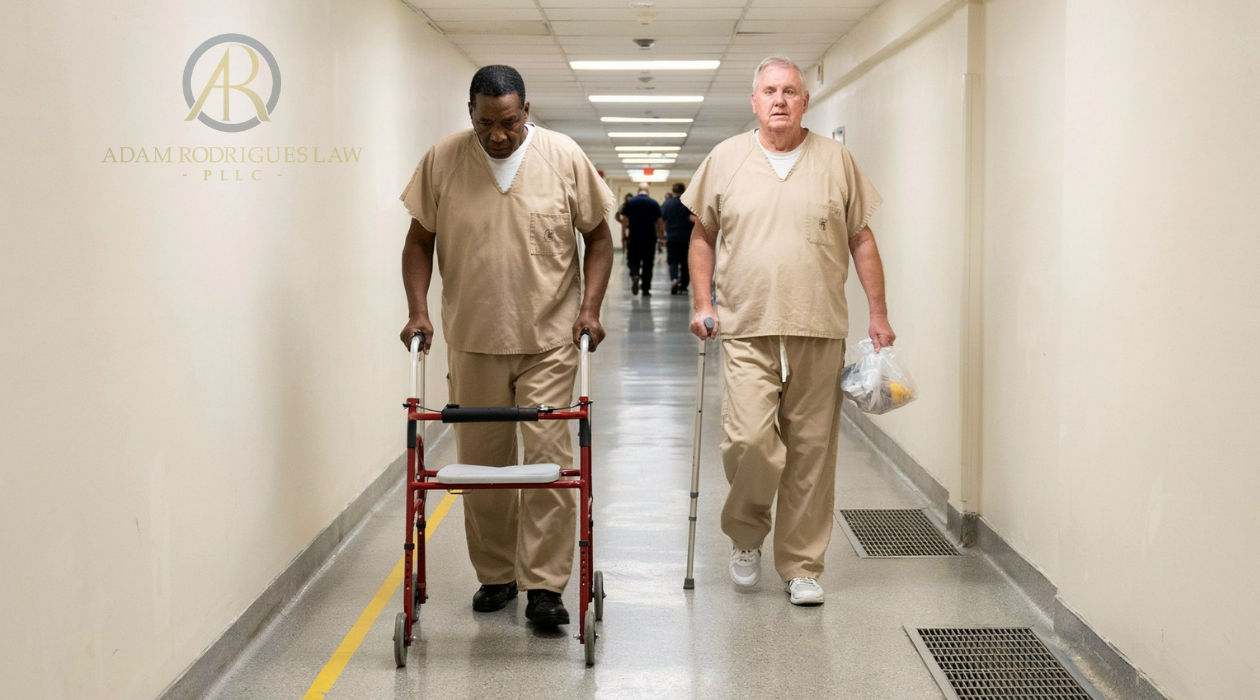
Serious medical conditions and age-related deterioration remain the strongest grounds for federal compassionate release after Rutherford and Fernandez. Successful motions typically require current medical evidence, exhaustion of Bureau of Prisons procedures, and proof that release is consistent with public safety and 18 U.S.C. § 3553(a)
Requirement 2: Advanced age with health decline
Age alone is not enough qualify; however, you can pair age with deterioration and time served. Under § 1B1.13, an inmate qualifies on age grounds if they are at least 65, are experiencing serious health decline from the aging process, and have served at least 10 years or 75% of the sentence, whichever is less. One reason courts take this category seriously is that health often falls off a cliff after years inside, and the Commission has made clear the reason does not have to have been foreseeable at sentencing.
Circumstances typically qualifying:
A 68-year-old with worsening heart disease who has served 12 years.
A 70-year-old with mobility loss and cognitive decline past the 75 percent mark.
An aging inmate whose conditions are stacking up faster than prison care can keep pace.
Circumstances typically failing:
A 66-year-old in good health who simply wants out.
An older inmate early in a long sentence with little time served.
Age claims with no medical record of actual decline.
Requirement 3: Family circumstances and the sole caregiver provision
The sole caregiver provision is one of the strongest grounds still fully intact after 2026, and it is the one families overlook most. Under § 1B1.13(b)(3), family circumstances qualify when the caregiver of the inmate's minor child (or an adult child incapable of self-care) dies or becomes incapacitated, when the inmate's spouse or registered partner becomes incapacitated and the inmate is the only available caregiver, or when the inmate's parent becomes incapacitated and the inmate is the only available caregiver. The Commission also allows similar circumstances involving other immediate family members. Nothing in Rutherford or Fernandez touched this category.
The keyword here is "only." The court needs to see that there is no one else, not that the inmate is the best option.
Circumstances typically qualifying:
The caregiver of a minor child dies or is incapacitated, and the inmate is the only remaining caregiver.
A spouse or registered partner is disabled by illness or injury and can no longer care for themselves or the children.
Documentation showing no other family member is able or available to step in.
Medical records or affidavits establishing actual incapacitation, not just hardship.
Circumstances typically failing:
Another relative is already caring for the children.
General family hardship or financial strain without death or incapacitation.
Sole caregiver claims with no proof that other options were ruled out.
Client Success Story
We won a compassionate release case on this exact sole caregiver provision. Our client's wife suddenly became paralyzed after a tragic car accident and could no longer care for their children, and there was no one else to step in. That is precisely what the sole caregiver provision under "extraordinary and compelling reasons”was written for, and luckily, 2026 rulings left this untouched.
If your family's situation changed while your loved one was inside, call a post-conviction attorney, like Adam Rodrigues law, who has a successful record in compassionate release cases.
Call Adam Rodrigues Law 615-270-2074 now or book your private consultation today.
The Two Mandatory Requirements: Exhaustion and the § 3553(a) Public-Safety Review
Even the strongest medical, age, or family-based case can fail if it does not clear two procedural hurdles that apply to every compassionate release motion. The first is administrative exhaustion. Before a federal judge can consider the request, the inmate must submit a written request for compassionate release to the warden. If the warden denies the request, the inmate must either complete the Bureau of Prisons' administrative appeal process or wait 30 days after the warden received the request before filing in federal court, as required by 18 U.S.C. § 3582(c)(1)(A). Courts routinely dismiss motions filed too early, even when the underlying medical condition appears compelling.
The second hurdle is the court's review of the sentencing factors in 18 U.S.C. § 3553(a). A qualifying medical condition alone does not guarantee release. The judge must decide whether reducing the sentence is consistent with the purposes of sentencing, including protecting the public, reflecting the seriousness of the offense, promoting respect for the law, and providing adequate deterrence. This is where your release plan does the work. A concrete plan showing where the person will live, who provides care, and how medical needs are met is what turns a qualifying diagnosis into a § 3553(a) finding the judge can actually make. For example, a terminally ill person with a well-documented release plan, strong institutional record, and low risk of reoffending may satisfy these factors. By contrast, someone with the same diagnosis but a recent history of prison violence, repeated disciplinary problems, or no stable release plan may still be denied compassionate release because the court concludes the § 3553(a) factors weigh against it.
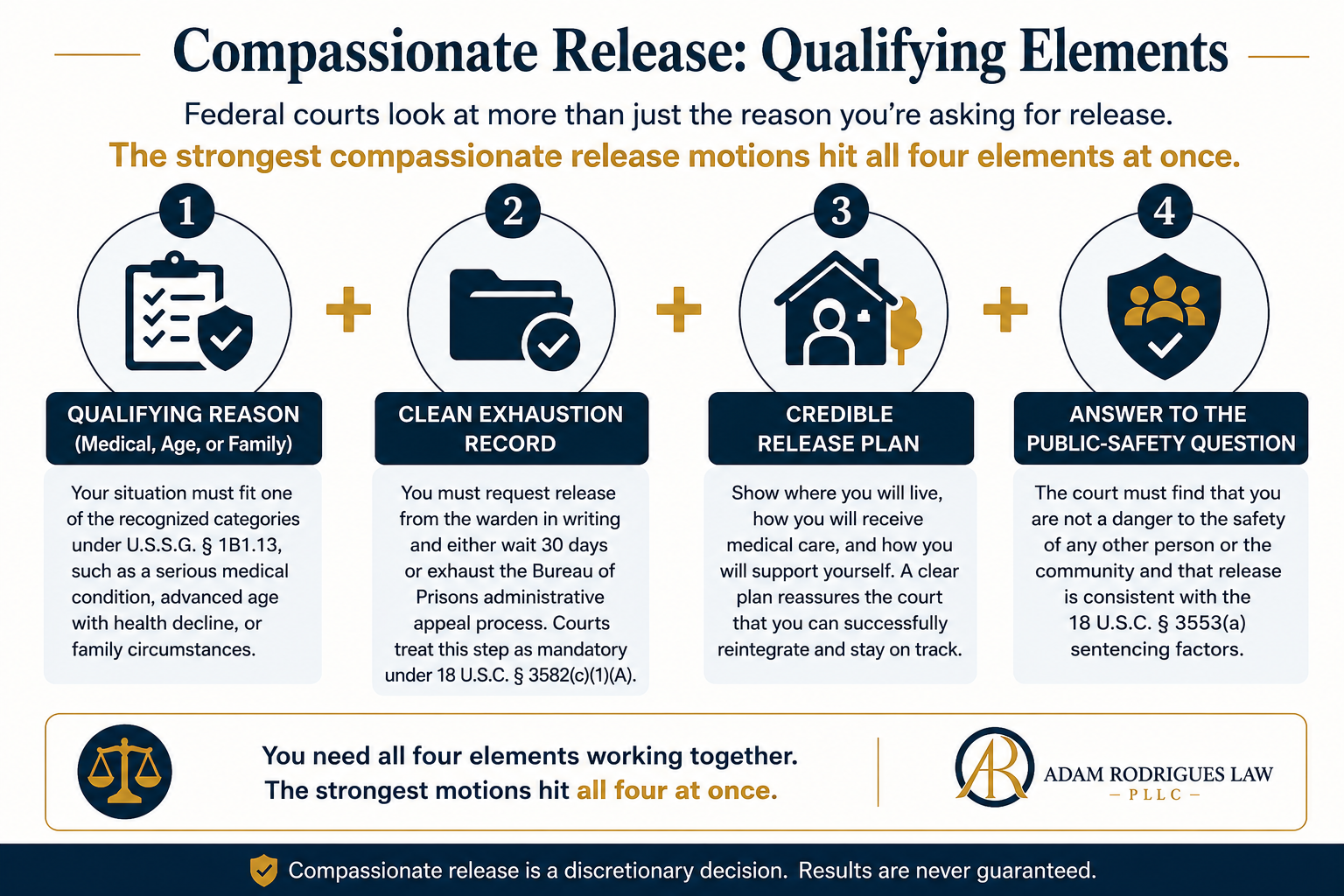
The strongest federal compassionate release motions satisfy all four qualifying elements: an extraordinary and compelling reason under U.S.S.G. § 1B1.13, proper administrative exhaustion with the Bureau of Prisons, a credible release plan, and a finding that release is consistent with public safety and the 18 U.S.C. § 3553(a) sentencing factors.
What this means for you: The grounds are not a menu where one box gets you out. You need a qualifying reason (medical, age, or family), a clean exhaustion record, a credible release plan, and an answer to the public-safety question. The strongest motions hit all four at once. However, all four of those elements apply to federal compassionate release cases. If your loved one is serving a state sentence in Tennessee or North Carolina, a different system applies.
How Does Compassionate Release Differ: Federal, Tennessee, and North Carolina?
Compassionate release in the federal sense is a creature of federal law, and the Rutherford and Fernandez rulings apply to federal sentences only. Tennessee and North Carolina run their own, separate early-release programs for sick and elderly state prisoners, and those state programs were not touched by the Supreme Court's 2026 decisions. Determining which path to compassionate release depends entirely on whether the sentence was imposed in federal or state court. See how they differ:
Federal: § 3582(c)(1)(A), now read more narrowly
Federal compassionate release is the path most people mean, and it is the one the Supreme Court just limited. Under 18 U.S.C. § 3582(c)(1)(A), a federal judge may reduce a sentence for extraordinary and compelling reasons after the person exhausts the request to the warden. And as we stated previously, after Rutherford, the disparity from a non-retroactive change like the end of § 924(c) stacking is no longer a qualifying reason, and after Fernandez, an innocence or trial-error claim must go through Motion to Vacate/Set Aside Sentence under 28 U.S.C. § 2255 instead. Luckily, there’s been no changes to the medical, age, and family grounds qualifying provisions.
Tennessee: medical and geriatric parole
Attorney Insight: Families mix these up constantly. A Tennessee state inmate cannot file a federal compassionate release motion, and a federal inmate cannot apply for Tennessee medical parole. The first question I ask is always simple: which court sentenced you, federal or state? Everything flows from that.
Tennessee handles sick and aging state prisoners through medical and geriatric parole, not through a § 3582-style motion. Tennessee law lets the Board of Parole release certain inmates who are 65 or older or terminally ill, found through Title 40, Chapter 28 of the Tennessee Code. Eligibility is conditioned on not being a career offender, not having escaped, posing low risk to the public, and not serving time for a list of the most serious violent and sexual offenses. This is a parole decision made by the Board, not a sentence reduction ordered by a judge.
North Carolina: medical release under Article 84B
North Carolina releases terminally ill, permanently disabled, and geriatric state inmates through its Medical Release program. Under N.C. Gen. Stat. § 15A-1369 and the rest of Article 84B, the Post-Release Supervision and Parole Commission can release an inmate who is terminally ill (a condition likely to cause death within nine months), permanently and totally disabled, or geriatric (55 or older with a chronic, incapacitating condition). People convicted of a capital felony or a Class A, B1, or B2 felony, and most registrants, are not eligible. An inmate (or inmate’s attorney) must first submit their request to the Division of Prisons, and within 45 days the Division of Prisons sends their recommendation to the Parole Commission. The Parole Commission must then make their decision within 15 days for a terminally ill inmate, or 20 days for a permanently disabled or geriatric inmate.
What this means for you: Find out which system you are in before you spend a dollar or a day on the wrong process. Federal sentence means § 3582(c)(1)(A) and the new limits from Rutherford and Fernandez. Tennessee or North Carolina sentence means a state medical or geriatric release track that the 2026 rulings did not change.
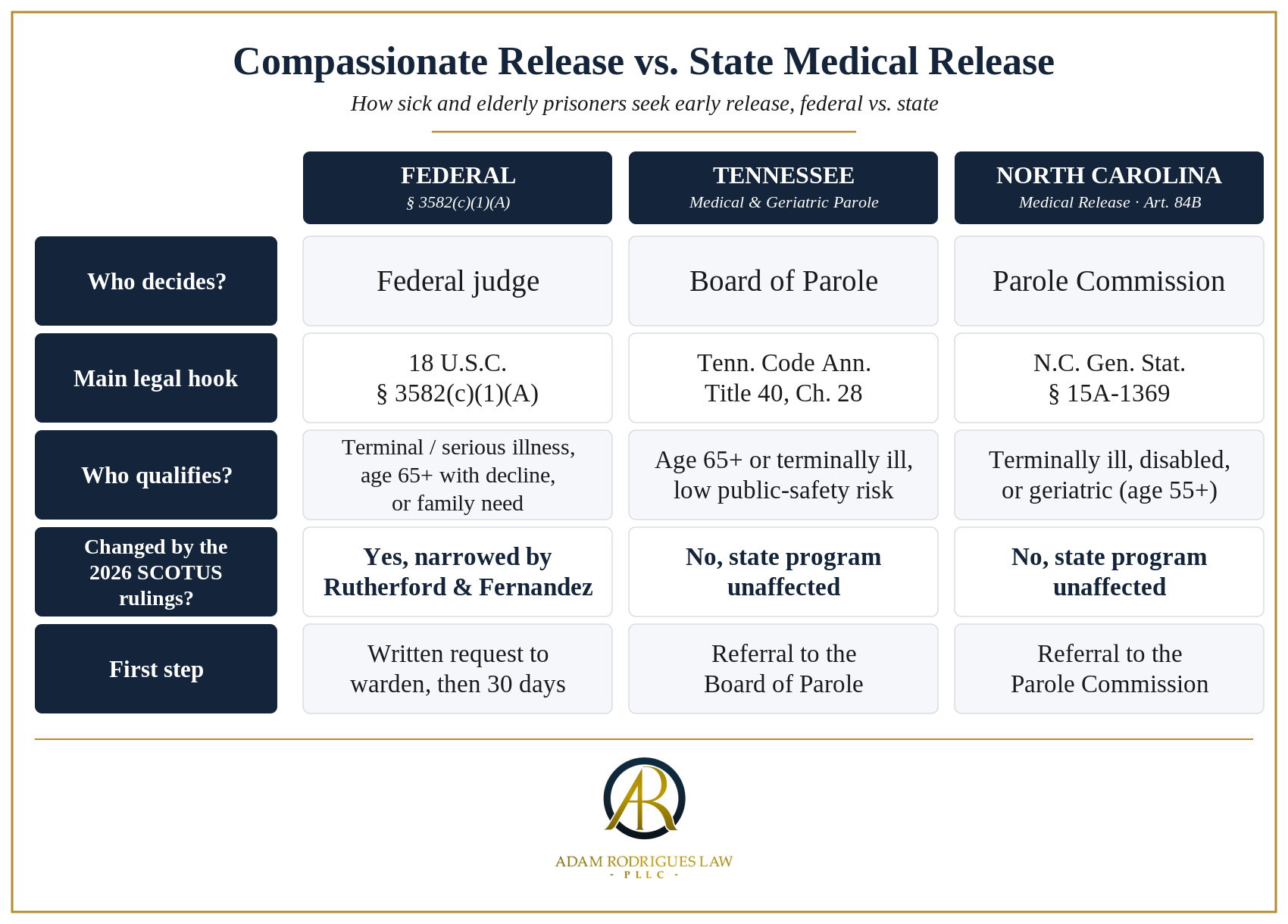
Federal vs. Tennessee vs. North Carolina Compassionate Release: This comparison chart highlights who qualifies, who decides each request, the governing law, and why the Supreme Court's Rutherford and Fernandez decisions affect only the federal compassionate release process, but not Tennessee or North Carolina state medical release programs.
Key Takeaway: The Supreme Court's 2026 rulings narrowed the federal track only. State medical and geriatric release in Tennessee and North Carolina runs on its own rules and remains available to qualifying state prisoners.
Next Steps
The clock and the paperwork both matter, and the warden's date-stamp is where the timeline starts. Whether the new rulings helped or hurt your case, the smart move is the same: build the strongest medical, age, or family record you can, and start the administrative step now so you are ready to file in court.
Immediate actions:
Gather current medical records, diagnoses, and prison treatment notes that document the qualifying condition.
Collect proof of any family caregiving emergency (affidavits, death certificates, physician letters).
Submit the written request to the warden and keep a dated copy, since the 30-day clock runs from that receipt.
Build a concrete reentry plan: where the person will live, who provides care, and how medical needs are met.
And contact legal counsel experienced in compassionate release cases like Adam Rodrigues Law before filing, because how the motion is framed after Rutherford and Fernandez now matters more than ever.
Think you or a loved may qualify for compassionate release?
If a non-retroactive law change or an innocence concern was your plan, do not give up, but get advice on the right vehicle. A vacatur and resentencing approach or a § 2255 habeas petition may fit where compassionate release no longer does.
We handle federal compassionate release and post-conviction relief, and we offer flat-rate pricing so you know the cost up front.
Call Adam Rodrigues Law 615-270-2074 now or book your private consultation today.
FAQs
-
No. After Rutherford v. United States (May 28, 2026), the disparity created by a non-retroactive change in law, including the First Step Act's end to § 924(c) stacking, can no longer be an extraordinary and compelling reason for compassionate release, alone or combined with other factors. There is a separate path: if an old stacked sentence is vacated for an independent valid reason and the person is resentenced, the lighter First Step Act penalties apply at that resentencing, which the Supreme Court confirmed in Hewitt v. United States (2025).
-
Yes. Serious medical conditions and terminal illness remain among the strongest grounds for compassionate release, and the 2026 rulings did not touch them. Under § 1B1.13, terminal illness qualifies without proof of a specific life expectancy, and serious conditions that prevent self-care and are not expected to improve can also qualify, backed by current medical records.
-
Largely, yes. In Fernandez v. United States, the Supreme Court held that a prisoner attacking the validity of his conviction must use habeas corpus under 28 U.S.C. § 2255, not compassionate release. Doubts about guilt or trial errors are no longer proper grounds under § 3582(c)(1)(A); those claims belong in a § 2255 petition.
-
No. Rutherford and Fernandez interpret the federal compassionate release statute and apply only to federal sentences. Tennessee state prisoners use medical and geriatric parole under Title 40, Chapter 28, and North Carolina state prisoners use medical release under N.C. Gen. Stat. § 15A-1369. Those state programs run on their own rules and were not changed by the Supreme Court's decisions.
-
First, submit a written request to the warden of the facility, clearly stating the extraordinary and compelling reason and attaching supporting documents. Then either wait 30 days from the warden's receipt with no decision, or exhaust the Bureau of Prisons appeal after a denial. Only then can the motion be filed in the federal court that imposed the sentence. Keep a dated copy of the warden request, because the clock starts there.
-
Compassionate release under § 3582(c)(1)(A) reduces a sentence for changed personal circumstances like illness, age, or family hardship, without disturbing the conviction. Habeas corpus under § 2255 challenges the conviction or sentence itself on legal grounds such as innocence or trial error. After Fernandez, you cannot use compassionate release to do what habeas is for.
-
A family member can start the process by sending the request to the warden on the inmate's behalf, and can hire an attorney to handle the case. But once the warden step is complete, the motion in court must be filed by the inmate (pro se) or by their lawyer, not by a family member in their own name.
Last Updated: June 30, 2026;
Related Blogs & Resources:
Transparent Pricing for Compassionate Release, Flat Rate: $8,500
U.S. Sentencing Commission's USSG §1B1.13 policy statement governing compassionate release under 18 U.S.C. § 3582(c)(1)(A)