
How to Prepare for Your Tennessee Parole Hearing
A Strategic Guide to Tennessee's Parole Process, Board Priorities, and How to Present Your Best Case
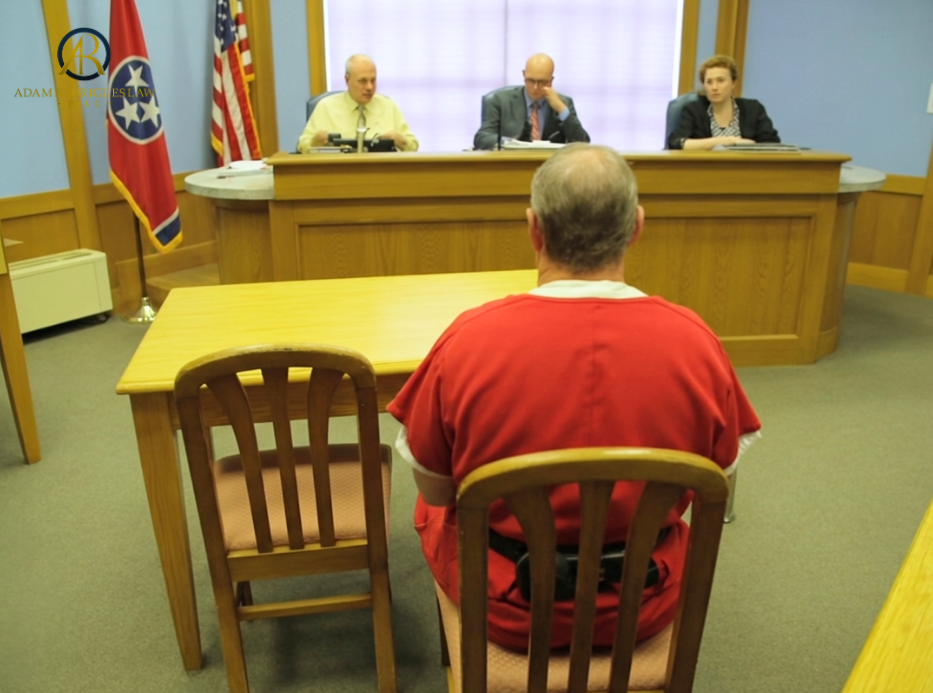
Most people walk into their Tennessee parole hearing unprepared, and that mistake can cost them years of their life.
Our guide breaks down exactly what the Tennessee Board of Parole is looking for, how to build the strongest possible case before your hearing date, and the most common errors that sink otherwise strong parole requests. Whether you're an incarcerated person getting ready to appear before the board, or a family member trying to help someone you love come home, this guide is for you.
We'll cover the board's actual decision-making criteria, how Tennessee's system compares to federal supervised release and what concrete steps you can take right now to improve the outcome. The parole process is not random, and it's not purely discretionary in the way most people assume. There is a structure to it, and understanding that structure is the first step toward presenting a compelling case.
TL;DR
The Tennessee Board of Parole evaluates risk assessment scores, institutional conduct, and documented rehabilitation when deciding whether to grant parole.
Parole eligibility depends on your offense classification, sentence structure, and time served, and not everyone gets a full hearing automatically.
Genuine remorse, accountability for the offense, and meaningful engagement with victim impact all carry significant weight with board members.
Family support letters, verified housing, employment prospects, and a concrete reentry plan are not optional extras, they are core parts of your case.
Minimizing the offense, blaming others, or arriving without documentation are the fastest ways to guarantee a denial.
Start building your hearing file now: gather program completions, support letters, and a written reentry plan, and consult with counsel about your risk classification.
What Does the Tennessee Parole Board Actually Care About?
The Tennessee Board of Parole is not simply deciding whether you've served enough time. The board is deciding whether you present an acceptable risk to public safety and whether you have a realistic plan to succeed outside. Those are two different questions, and understanding that distinction changes how you prepare. The board operates under Tennessee's official parole guidelines, which direct members to consider offense severity, criminal history, institutional behavior, rehabilitation programming, victim input, and your release plan. What the guidelines don't capture is how each factor plays out in practice and that's where preparation makes the real difference.
Risk assessment tools play a central role in every Tennessee parole hearing preparation. These instruments evaluate static factors like prior record and offense type, alongside dynamic factors like program participation and disciplinary history that you can actually influence. What consistently impresses the board is a documented pattern of institutional rehabilitation over time: completing substance abuse treatment, earning a GED or vocational certification, participating in cognitive behavioral programs, and maintaining a clean conduct record. One certificate is a data point. A consistent pattern over years tells a story, and the board responds to stories backed by evidence.
What hurts a parole case, often fatally, is minimizing the offense or deflecting responsibility at the hearing. People with strong institutional records can lose their chance at release because they stood in front of the board and explained why their conviction was unjust or why the victim was partly responsible. Even if some of that is true, the parole hearing is not the venue for those arguments. The board needs to hear that you understand the harm your offense caused, that you own it, and that you are genuinely different today. Arriving without documentation of program completions, with no reentry plan, or with vague answers about housing and employment will also raise serious red flags.
What This Means For You: Go into your hearing with a file, not just answers. Document every program, every positive evaluation, and every detail of your reentry plan before you sit down in front of the board. If you don't know your risk classification, find out now so you can address it head-on.
Key Points:
Risk assessment tools evaluate both static criminal history factors and dynamic rehabilitation factors you can influence before your hearing
Board members review your institutional file in advance and rely heavily on documented conduct, staff reports, and program history
Institutional conduct, including disciplinary record and program participation, is one of the board’s primary lenses
Rehabilitation evidence needs to be documented and verifiable, not just mentioned verbally
The hearing is not a trial or appeal, it is an evaluation of accountability, insight, and readiness for release
A clear, realistic reentry plan covering housing, employment, and supervision is essential
Common pitfalls include minimizing the offense, blaming others, arriving unprepared, and lacking a concrete reentry plan
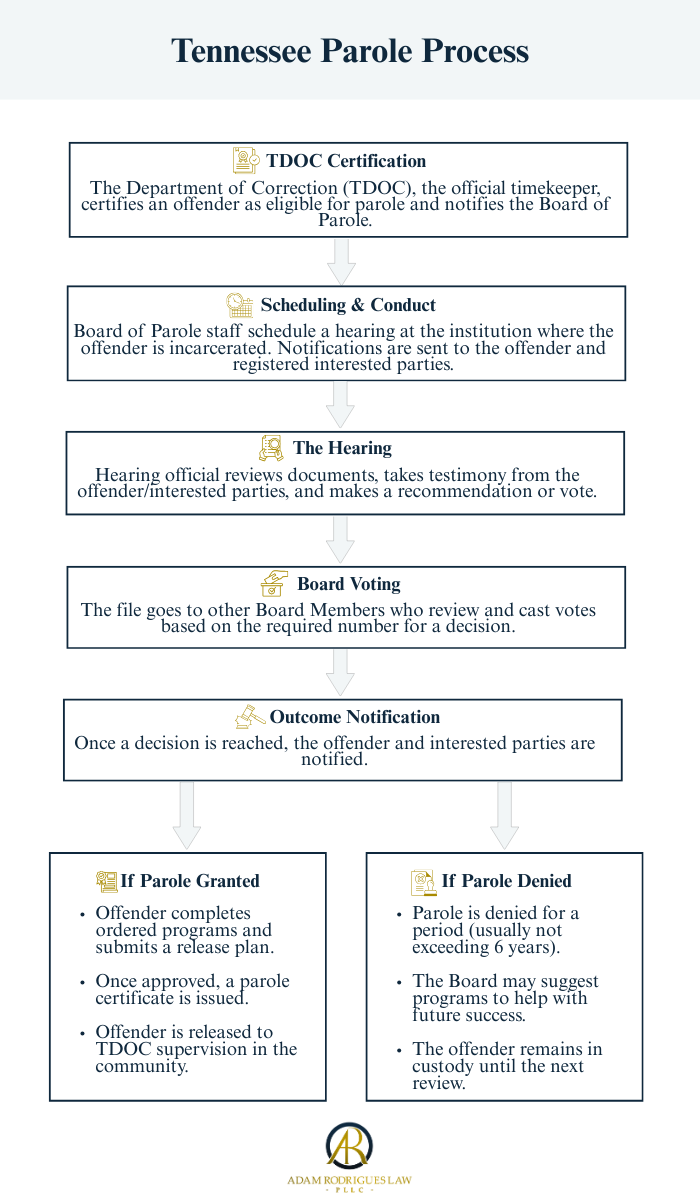
Official Tennessee parole process, at a glance, from TDOC certification through Board of Parole decision and outcomes. Hearing officers review the Board file and institutional file, use risk assessment plus release and revocation guidelines, and that Board members can adopt, modify, or reject recommendationsBased on procedures outlined by the Tennessee Board of Parole 2024-2025 Annual Report and explained and infographic by Adam Rodrigues Law PLLC.
How Does Tennessee Parole Differ with Federal Parole?
Understanding where Tennessee sits in the broader landscape helps explain why the board's priorities are structured the way they are. Tennessee parole hearing preparation looks different from federal supervised release planning and confusing them is a mistake families make often.
Federal Parole and Supervised Release
Federal parole was abolished by the Sentencing Reform Act of 1984 and does not exist for anyone convicted of a federal offense committed after November 1, 1987. What replaced it is supervised release, imposed by the sentencing judge as part of the original sentence rather than granted by a board after the fact. The U.S. Sentencing Commission (https://www.ussc.gov/) and the Bureau of Prisons (https://www.bop.gov/) govern how federal sentences are structured and how good-time credits apply, but there is no federal parole board reviewing cases for early release. Federal inmates seeking early release pursue compassionate release (https://www.adamrodrigueslaw.com/compassionate-release) motions under 18 U.S.C. § 3582(c)(1)(A), which are filed directly in federal court and governed by different standards entirely. If your family member is in federal custody and someone is advising them to prepare for a "parole hearing," clarify what mechanism is actually available — the preparation strategy is completely different.
Tennessee Parole Process
Attorney Insight:
Tennessee parole hearings are often shorter than people expect; sometimes under 15 minutes. That means the written file the board reviews before you walk in does most of the work. I build the case on paper first, then prepare my clients to speak to it clearly and genuinely in the room. Both pieces matter, and most people only think about one of them.
Tennessee's Board of Parole is a seven-member body appointed by the governor and confirmed by the state senate. It holds hearings and makes grant decisions on state sentences where parole eligibility exists. Not all Tennessee sentences carry parole eligibility — the shift toward determinate sentencing for many offenses has changed who can realistically appear before the board. For those who are eligible, the process involves an institutional file review, a formal hearing, and a board vote. Tennessee courts (https://www.tncourts.gov/) have addressed parole-related procedural questions in recent years, and the post-Dorsey v. McGee trends in 2024 drove a noticeable increase in parole and criminal appeals (https://www.adamrodrigueslaw.com/criminal-appeals) activity statewide as attorneys and families took a closer look at every available release mechanism. If your loved one is serving a sentence with parole eligibility, the Tennessee parole process is one of the most meaningful opportunities for early release available under state law (https://www.tn.gov/).
Key Takeaway: Tennessee's discretionary parole system gives eligible people a real opportunity to influence their release date, but it also puts the full burden on them to make a compelling case.
What Standards Must You Meet for Parole in Tennessee?
The board isn't running through a checklist. It's forming a judgment about risk and readiness, and that judgment draws on several overlapping categories of evidence. Understanding each one and how they interact is the foundation of serious Tennessee parole hearing preparation.
Tennessee Risk Assessment and Classification
Tennessee's Board of Parole uses structured risk assessment instruments that classify people before their hearings. These tools produce a score signaling low, moderate, or high likelihood of reoffending, and that classification shapes how the board approaches your entire file. A low-risk score doesn't guarantee release, but it removes a major obstacle. A high-risk score doesn't guarantee denial, but it raises the bar for what you need to show. The factors driving higher risk include prior criminal history, young age at first offense, substance abuse history, and limited community ties. The factors that offset a higher classification include strong program participation, a clean disciplinary record, verified housing and employment waiting on release, and meaningful family support. Knowing your classification before the hearing means you can build your presentation around the specific concerns it raises, rather than giving a generic account of your time inside.
Most common positives for your hearing:
You completed multiple evidence-based programs and have documentation for all of them
You maintained a clean disciplinary record for a sustained period, not just the months before the hearing
Your risk profile shows a clear downward trend based on documented dynamic factors
Potential negatives for your hearing:
You don't know your risk classification and haven't addressed the factors driving it
Your disciplinary record shows recent infractions that contradict claims of change
You have no verifiable housing or employment plan and no documented family support
Rehabilitation and Institutional Conduct
The board wants to see that you used your time inside to address the factors that contributed to your offense. Substance abuse treatment completion carries significant weight, particularly when the offense involved drugs or alcohol. Cognitive behavioral programs like Thinking for a Change are well-regarded and demonstrate engagement with the root causes of criminal behavior. Vocational certifications and educational achievement signal that you've built skills that support legitimate employment on the outside. Disciplinary infractions especially recent ones can seriously damage a parole case even when everything else is strong. If your record includes infractions, be prepared to acknowledge them honestly and explain what changed. Trying to minimize or explain away documented misconduct tends to backfire every time.
> Attorney Insight: It’s likely not the stack of certificates, it's the quality of your reflection on them. The answer to a board member’s question, whether it's specific and genuine or vague and rote, tells the board more than the paperwork. Prepare to talk about your programming in real terms, not just check it off a list.
Most common positives for your hearing:
Your disciplinary record is clean or shows a clear, sustained positive trend
You completed multiple programs and can speak specifically and genuinely about each
Correctional staff or officers have provided positive evaluations or letters on your behalf
Potential negatives for your hearing:
You have recent disciplinary infractions with no honest explanation
Your programming record shows enrollment without completion across multiple programs
You cannot speak specifically about what you actually learned in any program you completed
Victim Impact and Accountability
The board takes victim input seriously. Victim impact statements are reviewed before the hearing, and victim representatives sometimes attend or address the board directly. How you respond to that input and how you speak about your offense will tell the board more about your readiness for release than almost anything else. Genuine remorse is not the same as performed remorse. Board members have seen enough hearings to recognize the difference.
Genuine remorse means you can articulate the specific harm your offense caused to real people, without qualifying or minimizing it, and you carry that accountability as a settled part of who you are rather than a talking point you rehearsed. Parole reform research cited by the Department of Justice (https://www.justice.gov/) consistently shows that how people present accountability at hearings is one of the most influential factors in discretionary release decisions. The legal framework governing victim rights in parole proceedings is accessible at the Cornell Legal Information Institute (https://www.law.cornell.edu/), and understanding it helps explain why the board's attention to victim impact is neither optional nor ceremonial.
Most common positives for your hearing:
You articulate the specific harm your offense caused without being prompted
You express genuine understanding of the victim's perspective without challenging their experience
You've taken concrete steps like completed restitution and engaged in a restorative programming that shows accountability beyond words
Potential negatives for your hearing:
You describe your offense in ways that emphasize mitigating circumstances before clearly owning the harm
You express frustration about the victim's impact statement or suggest it's unfair
Your remorse sounds rehearsed or appears only when the question is asked directly
What this means for you:Risk assessment, rehabilitation record, and accountability don't operate in separate boxes. They work together to build a single picture of who you are today. The board is looking for coherence across all three, and a weakness in any one of them can undermine the others.

Successful parole candidates in Tennessee typically demonstrate sustained rehabilitation efforts, clean institutional records, and concrete reentry plans supported by family and community resources. Photo Credit: Core Civic
What to Do If Your Parole Hearing Is Coming Up?
If your hearing is scheduled or approaching, the time to prepare is right now, not the week before. The file the board reviews is built over time, and you cannot manufacture a pattern of sustained rehabilitation on short notice.
Immediate actions:
Start documenting every program completion, certificate, and positive evaluation and organize them into a clear, dated file
Gather support letters from family, employers, community members, or faith leaders who can speak specifically to your reentry prospects and changed character
Develop a written reentry plan that addresses housing, employment, treatment continuation, and support network in concrete, verifiable detail
Find out your risk classification and identify any concerns in your institutional record that need to be addressed or contextualized before the hearing
Contact experienced counsel to review your file, prepare your hearing strategy, and ensure the board has every piece of evidence that supports your release
Working with an attorney who has real experience with Tennessee parole hearings is a strategic decision, not a luxury. There is a real difference between clients who walk in with a prepared file and a clear narrative and those who try to handle it alone with good intentions, but no framework.
The key to Tennessee parole is superior preparation.
If you have a parole hearing scheduled. our flat-rate pricing means you'll know exactly what representation costs before you commit.
Call Adam Rodrigues Law 615-270-2074 now or book your private consultation today.
FAQs
-
At a Tennessee parole hearing, public safety risk and genuine evidence of rehabilitation top the list. The board evaluates whether you're likely to reoffend and whether you have a realistic path to success on the outside, using your risk score, institutional record, program completions, reentry plan, and how you take accountability for your offense. No single factor overrides the others, but a weak reentry plan or a minimizing attitude can sink an otherwise strong case.
-
Start early and document everything. Complete every evidence-based program available, maintain a clean disciplinary record, build a concrete reentry plan with verified housing and employment, and gather specific support letters. At the hearing, be prepared to own your offense without minimizing it.
An experienced attorney who knows the board's priorities, like Adam Rodrigues Law, can help you frame your case in the way most likely to resonate with the members reviewing your file
-
Don't minimize your offense, deflect blame onto others, challenge the fairness of your conviction, or express frustration with the victim's input. Avoid vague answers about your release plan like telling the board you'll "figure out housing" or "look for work" signals that you haven't prepared seriously.
The hearing is about your readiness for release, not the validity of your sentence.
-
Tennessee's Board of Parole typically issues its decision within a few weeks of the hearing, though timelines vary depending on case complexity and the board's caseload. You'll receive written notice of the decision, and if parole is granted, release is conditioned on approval of your specific release plan, including housing. Your attorney or case manager can help you track the timeline and respond promptly to any follow-up requests.
-
Tennessee law provides limited avenues for challenging a denial, including administrative reconsideration and, in cases involving procedural violations or due process concerns, state court review through the Tennessee courts system (https://www.tncourts.gov/). A denial also typically results in a future hearing date, and the intervening period is your opportunity to address whatever weaknesses the board identified. Call Adam Rodrigues Law after a denial to see if criminal appeals or other post-conviction options apply for your case.
Last Updated: April 7, 2026;
Related Blogs & Resources: