
Can New Evidence Reopen a Criminal Case?
Understanding Rule 33 Motions and State Analogs in Tennessee, North Carolina & Federal Court
Newly discovered evidence can potentially reopen a criminal case, but the path varies dramatically depending on whether you were convicted in federal court, Tennessee state court, or North Carolina state court.

Federal Rule 33 gives defendants three years to file a motion for new trial based on newly discovered evidence, while Tennessee allows only 30 days from sentencing, and North Carolina has a 10-day window for immediate relief followed by a complex Motion for Appropriate Relief system.
Understanding these deadlines and the strict standards courts apply is critical because missing the window or failing to meet the legal requirements can permanently foreclose this remedy. This guide explains what qualifies as newly discovered evidence, how the rules differ across jurisdictions, and what you need to do if you've uncovered information that could change your conviction.
TL;DR
Federal Rule 33: Motion for new trial based on newly discovered evidence must be filed within 3 years of verdict—but strict standards apply
Tennessee: 30-day deadline to file all new trial motions after sentencing, no extended period for new evidence
North Carolina: More complex—10 days for immediate post-trial relief, Motion for Appropriate Relief (MAR) system for later discovery
Key standard: Evidence must be (1) discovered after trial, (2) material and not cumulative, (3) likely to produce different result, (4) not discoverable earlier with due diligence
First step: Document exactly when and how you discovered the evidence, consult experienced post-conviction counsel immediately
Pricing: Post-conviction services vary by complexity. See flat-rate pricing.
What Qualifies as "Newly Discovered Evidence" Under Federal Rule 33?
Under Federal Rule of Criminal Procedure 33(b)(1), a defendant may move for a new trial based on newly discovered evidence within three years after the verdict or finding of guilty. In practical terms, this means if evidence surfaces after your trial that could change the outcome, you have a significant—but not unlimited—window to bring it to the court's attention. The rule recognizes that sometimes critical evidence doesn't come to light until witnesses change their stories, forensic technology advances, or documents surface that were previously unavailable. What matters is that the evidence is genuinely new to you and your legal team, not merely evidence you failed to discover through reasonable effort before or during trial.
Federal courts apply a five-part test that dates back decades and has been refined through countless appellate decisions:
(1) the evidence must be newly discovered since trial;
(2) the failure to discover it sooner must not result from lack of due diligence;
(3) the evidence must be material, not merely cumulative or impeaching
(4) the evidence must be likely to produce an acquittal upon retrial
(5) the motion must be timely filed within three years.
Each element carries weight, and failing any single one typically dooms the motion. Courts are particularly skeptical of evidence that a competent defense attorney could have uncovered with reasonable investigation before trial—the "due diligence" prong trips up many otherwise compelling claims.

Attorney Insight:
I've seen strong newly discovered evidence claims fail because the defendant or their original attorney should have found it earlier. For example, if a key witness was listed in the police report but never interviewed by the defense, courts often find that's lack of due diligence, not truly "new" discovery. The three-year clock is generous, but the substantive requirements remain demanding.
Types of Evidence Matters
DNA exonerations have become the most dramatic examples. Post-conviction DNA testing that excludes the defendant or identifies someone else can be powerful newly discovered evidence, especially if DNA technology has advanced since trial.
Recanting witnesses present thornier issues. Most circuits are deeply skeptical of witness recantations because they can be manufactured, coerced, or motivated by sympathy for a convicted defendant. A co-defendant's post-trial confession exonerating you may qualify, but courts scrutinize whether that testimony was truly unavailable at trial or whether the co-defendant simply chose not to testify.
Newly available documents like emails, text messages, or government records that surface through Freedom of Information Act requests or subsequent investigations can qualify if they genuinely weren't accessible earlier despite diligent efforts.
What does typically qualify as new evidence under a Rule 33 Motion?
Usually evidence that merely impeaches a witness about something peripheral, evidence that's cumulative of what was already presented, or evidence that would have been discoverable with reasonable investigation. If your attorney simply didn't pursue an obvious lead, that's usually considered trial error or ineffective assistance, which are grounds for different relief like post-conviction relief under 28 U.S.C. § 2255, not a Rule 33 motion.
What This Means for You: If you discover evidence after your federal conviction, you have up to three years to file a Rule 33 motion, but the evidence must meet strict requirements. Simply finding something your attorney missed isn't enough. The evidence must be truly undiscoverable before trial, go to a core issue in your case, and be strong enough that a jury would likely acquit you upon retrial.
What About § 2255 Motions Based on New Evidence?
Even if you miss or cannot meet Rule 33 requirements, newly discovered evidence may still provide a path to relief through a motion under 28 U.S.C. § 2255—particularly when that evidence supports a claim of actual innocence.
Section 2255 allows defendants to challenge a conviction or sentence on constitutional grounds, including claims involving actual innocence supported by new evidence. Courts are most receptive to forensic evidence, but in some cases, recantations or newly available testimony may be considered if they are credible and corroborated.
The timing rules are also different. Under § 2255(f)(4), the one-year filing deadline can begin from the date the new evidence could have been discovered through due diligence, rather than the date the conviction became final.
Courts often evaluate these claims through an “actual innocence” framework, which is demanding and requires strong, reliable evidence.
Key Point: Even if Rule 33 relief is unavailable, new evidence may still open the door to federal post-conviction relief; however, the standards are different and the arguments must be carefully structured.
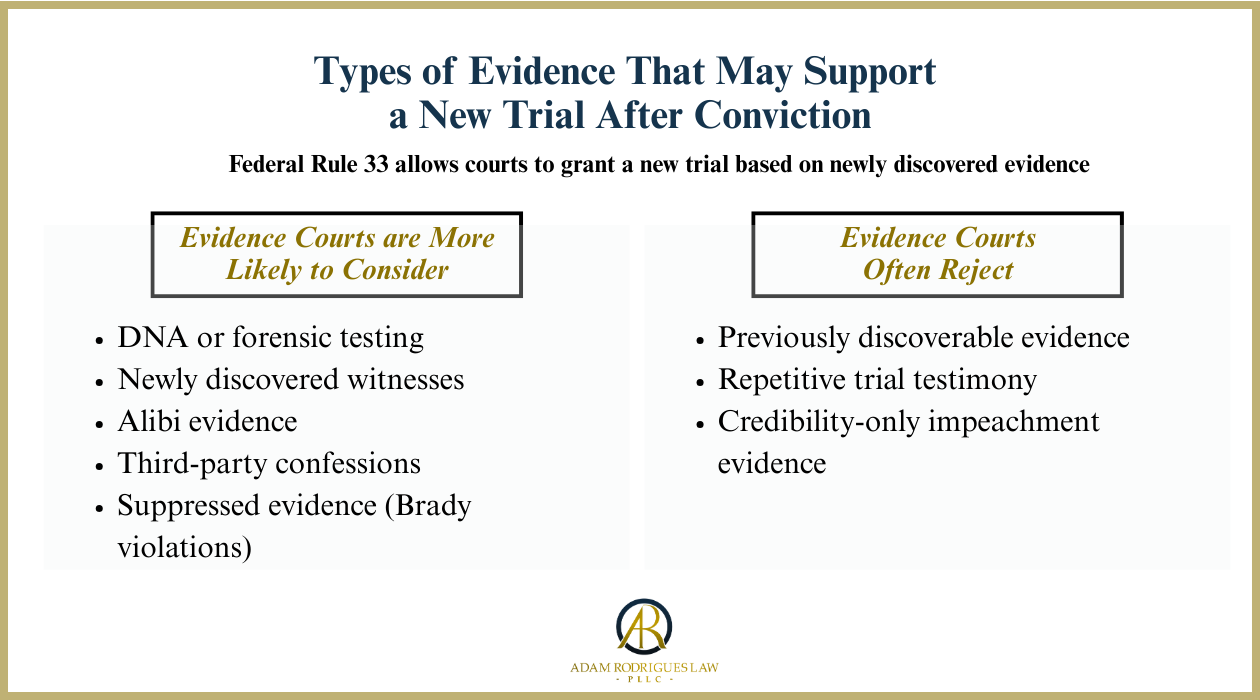
Examples of newly discovered evidence that courts may evaluate when considering a Rule 33 motion for a new trial.
Key Points:
Three-year deadline from verdict in federal court
Evidence must pass five-part test: newly discovered, due diligence shown, material, likely to produce acquittal, timely filed
DNA evidence and government document discoveries are strongest types
Witness recantations face heavy skepticism
How Do Tennessee's New Trial Rules Differ from Federal Law?
Tennessee's approach is fundamentally different and far less forgiving. Under Tennessee Rule of Criminal Procedure 33, all new trial motions must be filed within 30 days of sentencing, regardless of grounds. Tennessee provides no extended window for newly discovered evidence. The 30-day deadline is strict, jurisdictional, and inflexible.
If evidence surfaces 31 days after sentencing, your opportunity for a motion for new trial has closed permanently. Unlike federal court where you'd have years, Tennessee requires immediate action. The rule permits amendments to pending motions, so if you file timely and discover additional evidence before hearing, you can supplement. But that initial 30-day filing is mandatory. Miss it, and you're limited to post-conviction petitions under Tennessee Code § 40-30-101 et seq., with different standards and a one-year deadline after conviction becomes final.
Tennessee courts recognize newly discovered evidence as proper grounds, but you must raise it within 30 days. Standards mirror federal courts: material, not cumulative, likely to produce different result, not discoverable earlier with due diligence. Tennessee Rule 33(c)(2)(A) allows affidavit support, critical because newly discovered evidence often exists outside the trial record.
After 30 days, Tennessee Code § 40-30-117 allows post-conviction relief for "after-discovered evidence" under limited circumstances, requiring evidence so compelling no reasonable jury would have convicted you, a much higher bar than "likely acquittal."
Other Paths After the 30-Day Deadline
Although Tennessee’s 30-day motion for new trial deadline is strict, it does not eliminate all options if new evidence arises later.
Defendants may still pursue:
Post-conviction relief under Tennessee Code § 40-30-101 which allows claims based on constitutional violations, including certain claims involving newly discovered evidence.
Writ of error coram nobis, which has been expanded in recent years and can provide a pathway for newly discovered evidence that was not available at trial—particularly non-forensic evidence.
Tennessee courts have recognized that coram nobis relief may apply to non-forensic evidence, though the burden is high and courts closely examine credibility, timing, and diligence.
Key Points:
30-day deadline from sentencing order in Tennessee (no extensions)
All grounds for new trial, including newly discovered evidence, have same deadline
After 30 days, you must use post-conviction petition with higher standards
Tennessee's 30-day rule catches many defendants and attorneys by surprise
What this Means for You: Tennessee’s deadline for a new trial is strict; however, later-discovered evidence can still be raised through post-conviction or coram nobis proceedings; the tradeoff is that the legal burden becomes significantly higher.
What's North Carolina's Approach to New Evidence Claims?
North Carolina employs the most complex system, using multiple procedural vehicles depending on timing. For evidence discovered immediately after trial, North Carolina Rule 59 requires new trial motions based on newly discovered evidence "material for the party making the motion which he could not, with reasonable diligence, have discovered" be filed within 10 days after judgment. This deadline is tighter than Tennessee's 30 days and cannot be extended.
For evidence surfacing after 10 days, North Carolina has developed its Motion for Appropriate Relief system under North Carolina General Statutes §§ 15A-1411 through 15A-1422. MARs filed more than 10 days after judgment face narrower grounds and must overcome procedural hurdles, showing either "actual prejudice" or "fundamental miscarriage of justice."
Under G.S. § 15A-1419(e), fundamental miscarriage of justice requires showing "in light of newly discovered evidence, no reasonable juror would have found the defendant guilty." This exceeds federal court's "likely acquittal" test. You're arguing conviction becomes unreasonable, not merely that a different outcome is likely. For actual innocence claims, this framework provides a path, but the burden is steep.
North Carolina also has North Carolina Rule of Civil Procedure 60(b)(2) allows a court to relieve a party from a final judgment, order, or proceeding due to "newly discovered evidence which by due diligence could not have been discovered in time to move for a new trial under Rule 59(b).” This allows relief within one year, but primarily in civil cases and criminal defendants typically still proceed under MAR statutes.
What This Means For You:North Carolina has the most complicated system. You have 10 days for immediate post-trial relief, or you must file a Motion for Appropriate Relief with demanding standards. The MAR route requires showing "no reasonable juror would have found you guilty," not just that you likely would have been acquitted. Legal counsel is essential to navigate this system.
Key Points for North Carolina Cases:
10-day deadline for Rule 59 immediate post-trial motions
Motion for Appropriate Relief (MAR) system for later discoveries
MAR requires showing "fundamental miscarriage of justice" or "actual prejudice"
Standard is higher than federal court's "likely acquittal" test

Attorney Insight
North Carolina's MAR system is procedurally dense and unforgiving. I've worked on cases where we had compelling new evidence, a recanting witness whose trial testimony was the only direct evidence of guilt, but still faced an uphill battle showing "fundamental miscarriage of justice" rather than simply "likely acquittal." The state's standard is deliberately higher to preserve finality of judgments while still providing relief for truly wrongful convictions.
What Standards Must New Evidence Meet?
Even if you're within the deadline, your newly discovered evidence must satisfy multiple stringent legal requirements. Courts balance the need to correct wrongful convictions against preserving finality of judgments. Understanding these standards is critical because most newly discovered evidence claims fail not on timing, but on failing to meet one or more substantive requirements.
Due Diligence: You Must Show the Evidence Was Truly Undiscoverable
The due diligence requirement asks: should you or your attorney have found this evidence before or during trial through reasonable investigation? The standard is objective. Courts ask what a competent defense attorney would do preparing for trial. If that attorney would have uncovered the evidence, you failed due diligence, and the evidence isn't truly "newly discovered."
When due diligence works in your favor:
Post-trial forensic advances (DNA technology not available at trial)
Witness recantations after trial (can't discover lies before they're told)
Government Brady violations (prosecution hid exculpatory evidence)
Documents obtained through later Freedom of Information Act (FOIA) requests
Witnesses coming forward on their own after trial
When you'll fail the due diligence test:
Alibi witnesses who were known but never interviewed
Police reports your attorney didn't read carefully
Obvious investigative leads not pursued
Public records not subpoenaed
Witnesses listed in discovery but never contacted
Evidence timing matters. Evidence surfacing one month after trial looks more genuine than evidence appearing three years later, just before the deadline. Courts consider whether emergence seems organic (witness comes forward voluntarily, new technology becomes available) or manufactured (defendant contacts witnesses seeking recantations, family suddenly "remembers" alibi information).
Documentation is critical. When you discover new evidence, immediately memorialize how, when, and from whom you obtained it. Create timelines showing why earlier discovery was impossible. Get sworn affidavits from witnesses explaining why they didn't come forward sooner.
Materiality: The Evidence Must Go to a Core Issue
Materiality requires newly discovered evidence be "material," meaning it goes to a critical issue in the case, not peripheral details. Evidence merely impeaching a witness on something unimportant rarely suffices unless that witness's credibility was absolutely central.
Courts distinguish between exculpatory evidence (tends to show innocence) and impeachment evidence (attacks credibility). While both can matter, exculpatory evidence carries more weight. DNA excluding you as source of biological evidence is powerfully exculpatory. Evidence showing a prosecution witness had undisclosed prior convictions is impeachment.
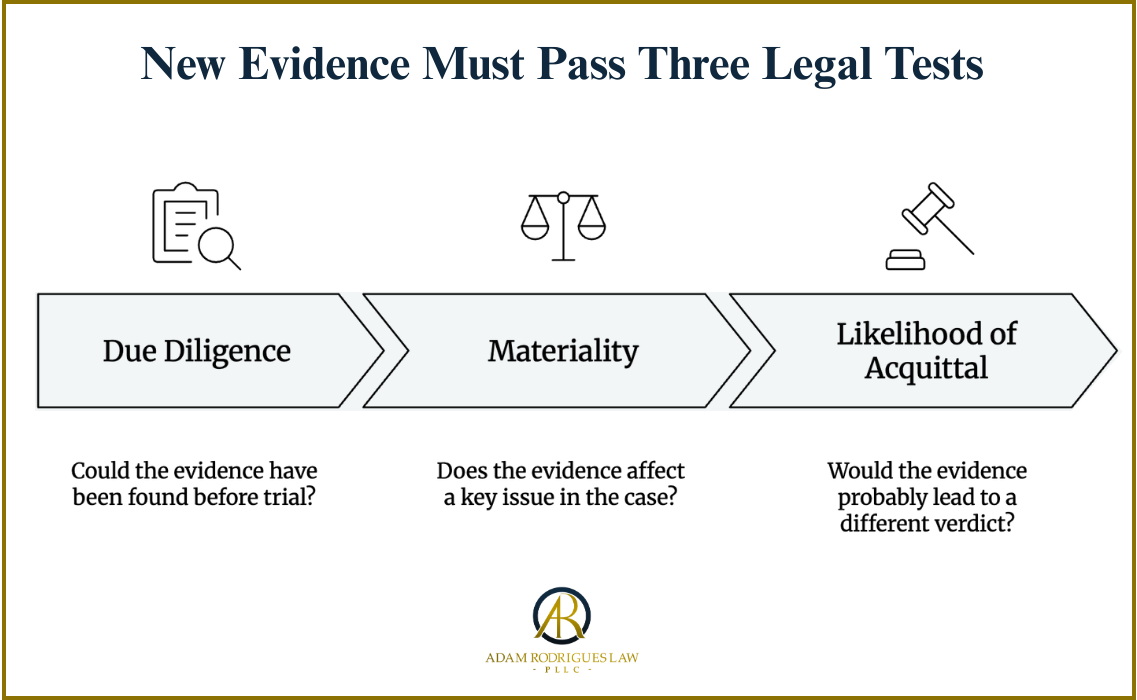
Courts evaluating Rule 33 motions require newly discovered evidence to satisfy three strict standards: due diligence, materiality, and likelihood the evidence would produce an acquittal.
Cumulative evidence almost never justifies new trial. If you presented three alibi witnesses at trial, a fourth saying the same thing adds little value. Courts reason if three didn't convince the jury, a fourth probably wouldn't either.
Evidence typically qualifying as material:
DNA testing excluding you or identifying alternative perpetrator
Alternative perpetrator confession with physical evidence
Government documents contradicting core prosecution theory
Medical evidence showing you were incapable of the crime
Key witness recantation when they were only direct evidence
Evidence typically failing:
Additional alibi witnesses repeating trial testimony
Impeachment on peripheral matters
Different expert saying same thing as trial expert
Evidence attacking minor witness inconsistencies
One federal court held that newly discovered evidence showing the actual murder weapon, different from the one prosecutors claimed, was material because it undermined the prosecution's core theory. Another found post-trial discovery of a prosecution witness's history as a paid police informant was material because it bore directly on motive to lie when that witness was the only direct evidence.
Likelihood of Acquittal: The Evidence Must Probably Change the Outcome
The final requirement asks: if the jury heard this evidence alongside everything else presented at trial, would they probably reach a different verdict? In federal court, most circuits require showing the evidence "would probably produce acquittal." This isn't "reasonable probability," it's higher. You must show acquittal would be the probable outcome, not merely possible or reasonably likely.
Courts assess:
The government's case strength at trial
How new evidence interacts with evidence already presented
Centrality of the issue addressed
New evidence credibility
Courts are particularly skeptical of recanting witnesses, suspiciously timed third-party confessions, and evidence surfacing years post-conviction.
North Carolina's G.S. § 15A-1419(e) is even higher, requiring "no reasonable juror would have found defendant guilty." You're arguing continued belief in guilt becomes unreasonable. Tennessee's standard mirrors federal court, requiring evidence would "likely produce a different result."
Successful examples:
DNA excluding defendant and identifying actual perpetrator
Key witness exposed as paid fabricating informant
Suppressed alternative suspect evidence discovered after trial
Physical evidence contradicting entire prosecution theory
Unsuccessful examples:
Fourth alibi witness when three testified at trial
Years-later recantations with questionable timing
Expert testimony supporting already-raised defenses
Evidence showing minor witness inconsistencies
What This Means for You: Your evidence must pass all three tests. Even if it's truly new and not discoverable earlier (due diligence), it must also be material and likely to produce acquittal. "Might help" isn't enough. The evidence must be strong enough that a new jury would probably reach a different verdict.
What to Do If You've Discovered Evidence?
If you have discovered evidence after conviction that could change the outcome, timing still matters, but strategy matters just as much. Federal defendants may have up to three years under Rule 33, Tennessee defendants face a 30-day deadline, and North Carolina defendants have a 10-day window for immediate relief followed by more demanding procedures.
Even if those initial deadlines pass, other legal paths may still be available, but the standards become significantly more difficult to meet.
Immediate actions:
Document exactly when, where, and how you discovered evidence
Get signed, sworn witness affidavits explaining what they know and why they didn't come forward sooner
Secure copies of physical evidence or documents, establish chain of custody
Create detailed timeline showing why earlier discovery was impossible
Contact experienced post-conviction counsel before deadlines expire
Key Point: Early action preserves the strongest legal options; later action is still possible, but requires meeting higher burdens and more complex procedural rules.
New evidence can’t wait.
An attorney familiar with Rule 33 motions and state analogs can assess whether evidence meets legal standards, advise on timing, and prepare motions before deadlines expire. Many claims fail not because evidence lacks merit, but because defendants wait too long, present improperly, or misunderstand governing standards.
Call Adam Rodrigues Law 615-270-2074 or book your confidential consultation where we evaluate your situation and offer immediate options best for you.
FAQs
-
Unfortunately not under Rule 33. If evidence was available and your attorney failed to pursue it, that's ineffective assistance of counsel, grounds for relief under 28 U.S.C. § 2255 or state post-conviction petitions, not Rule 33 "newly discovered evidence." Rule 33 is for evidence truly undiscoverable despite diligent effort, while ineffective assistance claims address attorney failures preventing proper investigation.
-
Although, you’ve missed the three-year Rule 33 deadline, you may still have options.
If evidence reveals constitutional violations or fundamental defects, pursue relief under 28 U.S.C. § 2255, though you must overcome the one-year deadline (extendable if factual basis "could not have been discovered" earlier with due diligence). If you can show actual innocence, that may open doors to successive habeas relief.
-
Courts are deeply skeptical. You need: sworn affidavit explaining in detail why they lied and what actually happened; corroborating evidence making recantation plausible; evidence you didn't coerce it; and consistency (prompt recantation, not years later). Even then, many courts may still deny relief on recantations alone unless testimony was absolutely central to conviction.
-
Not automatically. Courts consider: whether DNA testing was available at trial (if so, attorney failure may be ineffective assistance); whether DNA is dispositive (excludes you or merely shows someone else's DNA present); prosecution's trial theory (if they didn't rely on DNA, post-conviction results may be less impactful); and whether other guilt evidence remains overwhelming.
-
Yes, and often you should! If you discover evidence while in appeal window, file criminal appeal notice to preserve issues, then file Rule 33. However, Federal Rule 33(b)(1) provides courts cannot grant new trial while appeal is pending unless remanded. Your Rule 33 motion will be held until appeal concludes.
-
"Newly discovered" means evidence existed at trial but wasn't known despite diligent effort. "Newly available" means evidence existed and was known but couldn't be obtained (e.g., co-defendant who invoked Fifth Amendment at trial but now willing to testify). Most circuits hold newly available evidence doesn't qualify under Rule 33 because it wasn't "discovered" post-trial, just tactically unavailable.
-
Brady v. Maryland violations (prosecution suppressing material exculpatory evidence) support both Rule 33 and separate § 2255 constitutional claims. If you discover post-trial that prosecution withheld favorable evidence, you couldn't have discovered it with due diligence (it was hidden). Courts typically find due diligence satisfied. You must still show suppressed evidence was material and motion is timely. Brady violations extend § 2255's one-year deadline.
-
Yes, but only in limited circumstances. In federal court, Rule 33 allows up to three years for a new trial based on newly discovered evidence. After that, relief may still be possible under 28 U.S.C. § 2255 if the evidence could not have been discovered earlier and supports a claim of actual innocence. State systems like Tennessee and North Carolina impose stricter deadlines, with later options requiring significantly higher proof.
Last Updated: March 16, 2026;
Related Blogs:
Habeas Corpus Explained - Federal habeas petitions for challenging convictions
Debunking Top 5 Post-Conviction Relief Myths - Common misconceptions about timing and procedures
14 or 30 Days? Criminal Appeal Deadlines - Tennessee, North Carolina, and federal deadlines
Practice Areas:
Post-Conviction Relief - Motions for new trial, § 2255 petitions, state post-conviction matters
Criminal Appeals - Direct appellate representation
Habeas Corpus - Federal habeas petitions under 28 U.S.C. § 2254 and § 2255
Compassionate Release - Federal sentence reduction motions