
Denied Maternity Leave or Promotion After Pregnancy? That’s Illegal.
Legal Protections for Pregnant Workers Under Title VII, the PWFA, and Tennessee Law

You announced your pregnancy at work, and then everything changed.
Maybe you were on track for a promotion, and then suddenly you're "not ready." Maybe you asked about maternity leave and got told it would "jeopardize your position." Or maybe you came back from maternity leave to find your role had been quietly given to someone else.
If any of this sounds familiar, what happened to you likely wasn't bad luck. It was pregnancy discrimination and it's illegal under federal law, Tennessee state law, and a powerful new federal statute called the Pregnant Workers Fairness Act (PWFA).
This post breaks down exactly what protections you have, how employers violate them, and what you can do about it right now.
TL;DR
Pregnancy discrimination is illegal: Title VII of the Civil Rights Act of 1964 (Title VII), the Pregnancy Discrimination Act (PDA), and the PWFA all prohibit employers from treating you differently because of pregnancy, childbirth, or related conditions.
Tennessee adds its own protections: Under Tennessee Code Annotated § 4-21-408, known as the Tennessee Parental Leave Act, full-time employees with 12+ months of tenure are entitled to up to four months of leave for pregnancy, childbirth, and nursing.
The PWFA (effective June 2023) is a game-changer: Employers with 15+ employees must provide reasonable accommodations for pregnancy-related conditions. No more forcing you to choose between your health and your paycheck.
Retaliation is its own violation: If your employer punishes you for requesting leave, asking for accommodations, or filing a complaint, that's a separate illegal act.
Filing deadlines matter: You generally have 300 days to file an EEOC charge, but you should act well before that window closes.
First step: Document everything and contact an employment attorney. Book a confidential consultation.
What Laws Protect Pregnant Workers From Discrimination and Retaliation?
Here's what catches people off guard: the legal framework protecting pregnant workers is actually layered. Multiple federal statutes and Tennessee state law all work together, and most people don't know these protections exist until after their employer has already violated them.
Title VII of the Civil Rights Act of 1964, as amended by the Pregnancy Discrimination Act (PDA), covers employers with 15 or more employees. Under these laws, your employer can't:
Fire you or force you to resign
Demote you or deny you a promotion
Cut your hours or reassign your duties
Treat you differently from other employees with similar limitations
The law treats pregnancy discrimination as sex discrimination. Period.
The Pregnant Workers Fairness Act (PWFA), effective June 27, 2023, added something Title VII was missing: an explicit right to reasonable accommodations. Before the PWFA, pregnant workers had to squeeze accommodation requests through the ADA framework, which wasn't built for pregnancy. Now employers must engage in an interactive process and provide reasonable accommodations unless they can prove "undue hardship."
The EEOC is actively enforcing the PWFA. The EEOC's FY 2024 report is directly relevant to a pregnancy discrimination claim, as the agency filed its "first five lawsuits under the Pregnant Workers Fairness Act" that year, signaling active enforcement of this newer law that expands workplace protections for pregnant workers.
|With the EEOC recovering a record "almost $700 million for over 21,000 victims" and successfully resolving over 71% of mediations, a woman pursuing a claim has strong odds of meaningful financial recovery through either the administrative process or litigation.
Key Points:
Employers cannot force you to take leave if a reasonable accommodation would let you keep working
Requesting an accommodation cannot be held against you in performance reviews, promotions, or termination decisions
Protections extend to childbirth, miscarriage, stillbirth, lactation, and related medical conditions
You don’t need to have a disability to qualify for PWFA accommodations
How Does Pregnancy Discrimination Law Differ by Jurisdiction?
Where you work and where you file your claim matters. Federal law sets the floor, but Tennessee adds its own protections (and its own filing requirements).
A. Federal Law: Title VII and the PWFA
Under Title VII (42 U.S.C. § 2000e), employers with 15 or more employees cannot discriminate based on pregnancy, childbirth, or related conditions. The Pregnancy Discrimination Act clarified that pregnancy discrimination is a form of sex discrimination. This means all the protections that apply to sex-based discrimination, including the prohibition on gender stereotyping established in Price Waterhouse v. Hopkins, 490 U.S. 228 (1989), extend to pregnant workers.
The PWFA adds the accommodation requirement. The EEOC’s final rule, effective June 18, 2024, spelled out that covered accommodations include schedule changes, remote work, additional breaks, temporary reassignment, and time off for medical appointments. In its first full fiscal year, the EEOC received over 2,700 PWFA-related charges and filed multiple enforcement lawsuits.
The Family and Medical Leave Act (FMLA) provides up to 12 weeks of unpaid, job-protected leave for eligible employees. You qualify if you’ve worked for your employer for at least 12 months, logged at least 1,250 hours in the past year, and your employer has 50 or more employees within 75 miles.
Deadline to file federally: 300 days from the discriminatory act to file with the EEOC.
What this means for you: If your employer has 15 or more employees, you’re protected under both Title VII and the PWFA. Tennessee employees with 8 or more coworkers also get state-level protections under the THRA.
B. The Tennessee Human Rights Act (THRA) Advantage
Tennessee takes a layered approach. Tennessee Human Rights Act (THRA) (T.C.A. § 4-21-101 et seq.) prohibits sex-based employment discrimination, which includes pregnancy discrimination, for employers with 8 or more employees. That lower threshold means more Tennessee workers are covered under state law than under federal law.
Tennessee also has its own Pregnant Workers Fairness Act (PWFA), requiring employers to provide reasonable accommodations for pregnancy-related conditions. And under Tenn. Code Ann. § 4-21-408, employees who have worked full-time for the same employer for at least 12 consecutive months may take up to four months of leave for adoption, pregnancy, childbirth, and nursing.
The State of Tennessee offers broader protection through the This is often the saving grace for many employees because the THRA typically applies to employers with 8 or more employees. This state law provides crucial coverage for thousands of individuals working for smaller, local businesses that fall below the federal 15-employee threshold.
Employer Size & Deadline Guide (Federal & Tennessee)
Title VII (42 U.S.C. § 2000e)/PWFA:
Employer Size: 15+ employees
Accommodation Required: Yes (PWFA)
Leave Entitlement: 12 weeks unpaid (FMLA, 50+ employees)
Filing Deadline: 300 days (EEOC)
Tennessee Human Rights Act (THRA)/TN PWFA:
Employer Size: 8+ employees
Accommodation Required: Yes
Leave Entitlement: Up to 4 months (12-month employees)
Filing Deadline: 1 year (THRC)
What this means for you: If you’re a Tennessee worker, regardless of where your employer’s headquarters are, you may have claims under both federal and state law. Filing under both gives you more leverage and potentially more remedies.

How Do You Prove Pregnancy Discrimination and Retaliation?
Having legal protections is one thing. Proving your employer violated them is another. Courts and the EEOC look for specific types of evidence, and the earlier you start building your case, the stronger it will be.
Direct Evidence
The strongest pregnancy discrimination cases involve direct evidence, meaning statements or actions that explicitly tie the adverse employment decision to your pregnancy. This includes comments like “we need someone who isn’t going to be distracted by a baby” or emails discussing how your pregnancy will “create problems” for the team.
Direct evidence is rare because most employers know better than to say the quiet part out loud. But it happens more often than you’d think, especially from direct supervisors who haven’t been trained on employment law.
When you’ll have direct evidence:
Manager or HR made comments about your pregnancy affecting your work
Emails or texts referencing your pregnancy in connection with a negative decision
Written policies that treat pregnancy differently from other medical conditions
Witnesses who heard discriminatory statements
When you’ll need to rely on circumstantial evidence:
The timing between your pregnancy announcement and the adverse action
Similarly situated non-pregnant employees being treated more favorably
A pattern of the employer treating pregnant workers differently
“Pretextual” reasons (aka: an action, reason, or explanation that is contrived to hide a person's true, often dishonest, motives) that don’t hold up under scrutiny
Attorney Insight: Timing is your best friend in these cases. If you were Employee of the Month in January, announced your pregnancy in February, and got a performance improvement plan in March, that timeline tells a story.
2. Retaliation
Retaliation claims are often stronger than the underlying discrimination claim. Under both Title VII and the PWFA, your employer cannot punish you for requesting an accommodation, filing a complaint, or participating in a discrimination investigation.
Pregnancy Retaliation Examples in the Workplace:
Termination or demotion after you requested pregnancy accommodations
Being excluded from meetings, projects, or promotion opportunities after filing a complaint
Sudden negative performance reviews after announcing your pregnancy
Having your schedule changed or hours reduced after returning from maternity leave
Being transferred to a less desirable position after requesting leave
The legal standard for retaliation is lower than for discrimination. You don’t have to prove you were actually discriminated against. You only need to show that you engaged in a protected activity (like requesting accommodations or filing a complaint) and that your employer took an adverse action against you because of it.
How Pregnancy Discrimination Cases are Proven in Court: The McDonnell Douglas Framework
Most pregnancy discrimination cases follow the burden-shifting framework from McDonnell Douglas Corp. v. Green, 411 U.S. 792 (1973). You establish a prima facie case by showing that (1) you were pregnant, (2) you were qualified for your position, (3) you suffered an adverse employment action, and (4) the circumstances suggest discrimination. Then the burden shifts to your employer to offer a legitimate, non-discriminatory reason. Finally, you get the chance to show that reason is pretextual, and ultimately the courts decide.
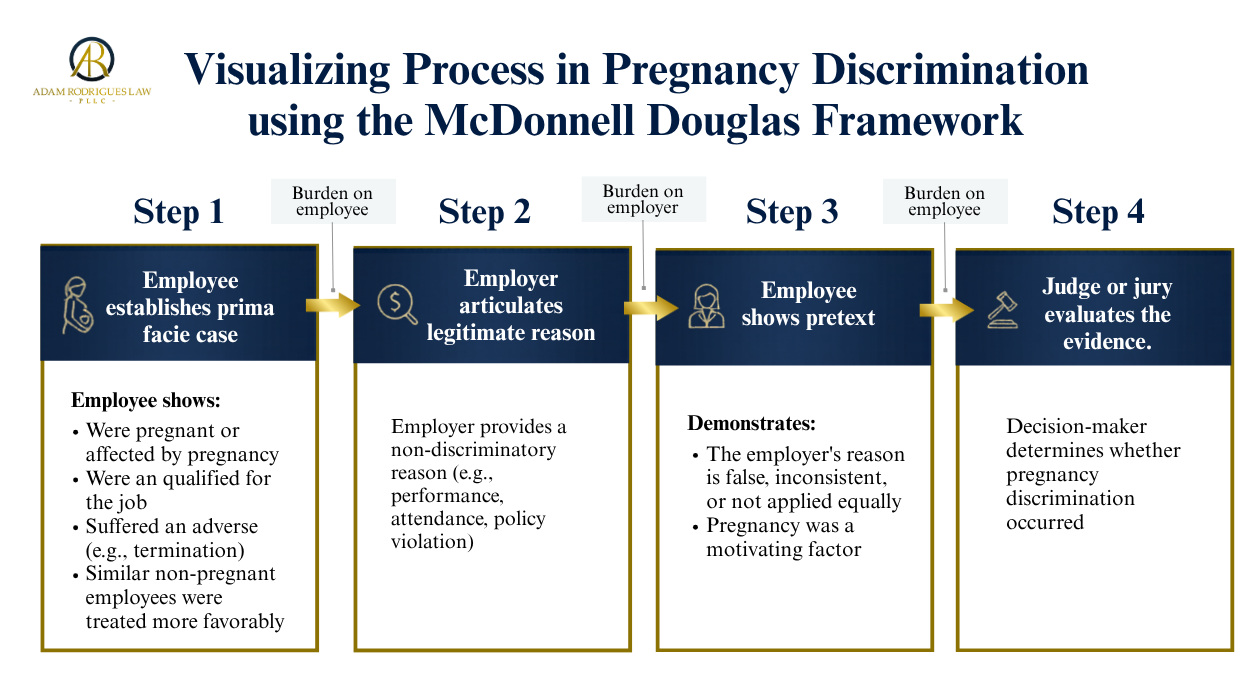
This visual breaks down the McDonnell Douglas burden-shifting framework used in pregnancy discrimination cases, including how employees prove discrimination and how employers defend claims. Created by Adam Rodrigues Law, serving employment law cases in Tennessee.
In Ensley-Gaines v. Runyon, a case still recognized by courts today, the McDonnell Douglas framework was applied to evaluate a pregnancy discrimination claim involving a denied accommodation. In 1996, a pregnant employee requested light duty but was refused, even though other non-pregnant employees with similar work limitations had been granted accommodations.
Using the framework, the employee first established a prima facie case by showing she was pregnant, qualified, denied accommodation, and treated less favorably than comparable employees. The employer then offered a legitimate reason for the denial. But at the pretext stage, that explanation broke down because the evidence showed inconsistent treatment. The court ultimately made clear that pregnancy discrimination can be proven when employers treat pregnant workers worse than others similar in their ability to work, reinforcing that these cases often turn on comparator evidence rather than direct proof of bias.
Key points:
Start documenting from the moment you suspect something is wrong
Save emails, texts, performance reviews, and any written communications
Note dates, witnesses, and specific statements
Don’t rely on your employer’s internal complaint process alone
What this means for you: You don’t need a confession from your employer. Simply showing a strong pattern of circumstantial evidence, particularly suspicious timing and inconsistent treatment, can help you win your case.
Next Steps: What to Do If You’ve Been Discriminated Against Because of Your Pregnancy?
If you’ve been denied a promotion, fired, or retaliated against because of your pregnancy, time matters. Federal and state filing deadlines are strict, and the evidence you need is easiest to gather while you still have access to it.
Immediate Actions:
Document everything now. Save copies of emails, texts, performance reviews, accommodation requests, and any written communications to a personal device or account. Don’t wait until after you’ve been locked out of company systems.
Write a detailed timeline. Include when you announced your pregnancy, when you requested accommodations or leave, and when negative actions began. Note specific dates, what was said, and who was present.
Identify witnesses. Coworkers who heard discriminatory comments or noticed a change in how you were treated can be critical. Write down their names and what they observed.
File your complaint before deadlines expire. You have 300 days to file with the EEOC for federal claims, and one year to file with the Tennessee Human Rights Commission for state claims. Missing these deadlines can permanently bar your claims.
Consult an employment law attorney. Consult an employment attorney like Adam Rodrigues immediately if you suspect illegal conduct. Acting promptly is crucial to ensuring your Federal, Tennessee claims (or both) are filed within the allowable statute of limitations. If your termination or mistreatment violated state or federal law, you may have a strong case for legal action.
An experienced employment attorney can also assess what damages you may be entitled to. Depending on your case, remedies may include back pay (covering lost wages and benefits from the date of the adverse action), front pay (projected future earnings if reinstatement isn’t practical), compensatory damages for emotional distress, and punitive damages in cases involving willful violations. Under federal law, combined compensatory and punitive damages are capped based on employer size, ranging from $50,000 for employers with 15-100 employees up to $300,000 for employers with 500+ employees. Tennessee state claims may offer additional avenues for recovery.
Our firm handles employment discrimination matters on a case-by-case basis. We offer transparent, flat-rate pricing so you know what to expect from the start.
Pregnancy can’t get you fired. You have rights.
Our firm handles employment law discrimination matters for Tennessee-based residents. We offer transparent, flat-rate pricing so you know what to expect from the start.
Call Adam Rodrigues Law 615-270-2074 now or book your private consultation today.
FAQs
-
No. Firing an employee because of pregnancy is illegal under both federal and Tennessee law. Title VII of the Civil Rights Act, as amended by the Pregnancy Discrimination Act, prohibits employers with 15 or more employees from terminating workers based on pregnancy, childbirth, or related medical conditions.
The Tennessee Human Rights Act (THRA) further extends that protection to employers with just 8 or more employees. Your employer also cannot force you to resign, cut your hours to push you out, or eliminate your position as a workaround. If the timing of your termination lines up with your pregnancy announcement, that pattern alone can support a discrimination claim.
-
The Pregnant Workers Fairness Act (PWFA) is a federal law that took effect on June 27, 2023. It requires employers with 15 or more employees to provide reasonable accommodations for limitations related to pregnancy, childbirth, or related medical conditions, unless the accommodation would impose an undue hardship. Tennessee workers are fully covered. Reasonable accommodations under the PWFA include additional breaks, access to water, seating, schedule modifications, temporary reassignment of heavy lifting, remote work, and time off for prenatal appointments. Your employer must engage in an interactive process with you to identify accommodations. They cannot force you to take leave instead of providing an accommodation, and they cannot retaliate against you for requesting one.
Tennessee also has its own state-level Pregnant Workers Fairness Act that provides similar protections.
-
You have two primary options:
For federal claims under Title VII or the PWFA, file a charge of discrimination with the EEOC within 300 days of the discriminatory act.
Tennessee has EEOC offices in Nashville (220 Athens Way, Suite 350) and Memphis (1407 Union Avenue, Suite 521), and you can also file online at eeoc.gov.
For state claims under the Tennessee Human Rights Act, you have one year from the discriminatory act to file with the state. The EEOC and Tennessee's state agency have a work-sharing agreement, so filing with one agency can automatically cross-file with the other. Filing a federal charge is a required first step before you can bring a lawsuit under Title VII.
An employment attorney, like Adam Rodrigues Law can help you determine whether to file under federal law, state law, or both, based on your employer's size and the specifics of your case. Call today 615-270-2074
You must file a notarized complaint form with the THRC within 180 days of the last act of discrimination. The THRC will investigate the claim and may offer mediation. Filing with the THRC also dual-files your charge with the federal EEOC. This process is complex, and many plaintiffs benefit from legal guidance to ensure their initial charge clearly outlines the legal basis for the claim.
-
Retaliation occurs when your employer takes an adverse action against you because you exercised a legal right related to your pregnancy. Under Title VII and the PWFA, protected activities include requesting a pregnancy accommodation, filing a discrimination complaint, taking FMLA or parental leave, or participating in an investigation.
Retaliation can take many forms: termination, demotion, sudden negative performance reviews, exclusion from meetings or promotion opportunities, schedule changes, hour reductions, or transfer to a less desirable position. The legal standard for proving retaliation is lower than for discrimination itself.
You don't need to prove the underlying discrimination occurred. You only need to show that you engaged in a protected activity and your employer took action against you because of it. Timing is often the strongest evidence. Courts in the Sixth Circuit (which covers Tennessee) closely examine the gap between the protected activity and the adverse action.
-
Recovery depends on which laws apply and the specific facts of your case. Potential damages include back pay (lost wages and benefits from the date of the adverse action), front pay (projected future earnings if reinstatement is not practical), compensatory damages for emotional distress, and punitive damages for willful violations.
Under federal law (Title VII), combined compensatory and punitive damages are capped based on employer size: $50,000 for employers with 15 to 100 employees, $100,000 for 101 to 200, $200,000 for 201 to 500, and $300,000 for employers with more than 500 employees. Tennessee state claims under the THRA may offer additional avenues for recovery. You may also be entitled to attorneys' fees and court costs. Settlement amounts in pregnancy discrimination cases vary widely. EEOC-resolved cases have ranged from tens of thousands to over $200,000, and jury verdicts in severe cases have reached into the millions.
Every case is different, so call Adam Rodrigues Law today 615-270-2074 for a private consultation where we can evaluate what your specific claim may be worth.
-
Tennessee employees have leave protections under both federal and state law. The Family and Medical Leave Act (FMLA) provides up to 12 weeks of unpaid, job-protected leave if you have worked for your employer for at least 12 months, logged at least 1,250 hours, and your employer has 50 or more employees within 75 miles.
Under Tennessee's parental leave law (Tenn. Code Ann. Section 4-21-408), employees who have worked full-time for the same employer for at least 12 consecutive months are entitled to up to four months of leave for pregnancy, childbirth, adoption, and nursing. You must provide three months' advance notice unless a medical emergency prevents it. After leave, you have the right to return to your same position or a substantially similar one. Your employer cannot eliminate your role, demote you, or reduce your pay while you are on protected leave.
If both laws apply, you are entitled to whichever provides the greater benefit.
-
No. Denying a promotion because of pregnancy is unlawful sex discrimination under Title VII and the Tennessee Human Rights Act . Your employer cannot assume that your pregnancy will affect your ability to perform the job, reduce your commitment, or make you less available. The Supreme Court's decision in Price Waterhouse v. Hopkins, 490 U.S. 228 (1989) established that employment decisions based on gender stereotyping, including assumptions about pregnant workers, violate Title VII.
If you were qualified for the promotion and the decision coincided with your pregnancy announcement or accommodation request, that timing can be strong evidence of discrimination. You should document any statements from supervisors about your pregnancy in relation to the promotion decision, keep records of your qualifications and performance history, and note whether a non-pregnant employee received the promotion instead.
Last Updated: June, 15, 2026
Related Blogs & Resources: